
“But governing oneself by examples is undoubtedly very dangerous in similar circumstances if the conditions do not correspond, not only in general but in all particulars, and if things are not managed with similar judgment, and if, aside from all other fundamentals, one does not have similar good fortune on one’s side.”
-Francesco Guicciardini, History of Italy
Last piece, we looked at the factors that make strategy uniquely difficult. Aside from the inherent difficulty of spanning the civilian-military divide, it involves many different non-military elements (diplomacy, industrial production, economic policy, etc.) whose specialists have little experience working together; as such, there is no natural apprenticeship for either political leaders or generals. Strategy also demands that one both define one’s own objectives and carry them out, creating a difficult recursive problem when one factors in the enemy’s will. Taken together, this means that every strategic problem is unique.
As Guicciardini noted, the subtleties and texture of a situation can profoundly alter the nature of a problem, radically altering one’s strategic calculations. Unlike tactical and operational case studies, history does not even provide a template for strategic decision-making. Guicciardini wrote in the 16th century, a time when humanist advice on statecraft was gilded with glib allusion to classical antiquity—he held a dim view of his friend Machiavelli’s political idealism (the quote at the top refers to Piero de’ Medici’s hapless attempt to imitate his illustrious father Lorenzo’s example). In our own day, more recent history is invoked—World War II above all—as a guide to decision-making.
It is worth exploring just how different strategic decision-making can be even when the overall picture is superficially similar. Subtle differences in the larger political situation can completely alter a state’s choices, while superficially similar actions are usually driven by fundamentally different logic. Beyond that, what we uniformly call “strategy” encompasses a much wider set of activities than other levels of war—activities that extends far beyond the strictly military.
Strategic Tempo
Let us start with two scenarios that are very similar in their bare outline: 18th-century Prussia and its 20th-century successor Imperial Germany. Both were located in the middle of Europe, surrounded by hostile neighbors, and lacked terribly defensible borders. This compelled them to mobilize quickly and strike hard at the outbreak of a war. Once hostilities were underway, their primary concern was shifting forces to the most urgent theater while keeping their allies on board.
That was certainly the pattern during the Seven Years’ War and First World War. In the broadest terms, the two followed a similar course: after their initial effort to land a knockout blow failed (in Bohemia and France, respectively), there followed several years of shuttling forces between theaters. They also had to give attention to non-essential theaters to keep valuable allies in the war: Frederick the Great sent one of his most competent generals, Duke Ferdinand of Brunswick-Wolfenbüttel, to Hanover to aid Great Britain, while the Imperial Germans sent armies to the southeastern front to shore up their Austrian allies.
Choosing how to allocate resources to different theaters is one of the most fundamental questions of strategy; yet the material differences between the two cases was enough to make them in essence two completely different questions. In particular, the tempo of these shifts determined the nature of the problem.
For Frederick the Great, shifting forces was something that could be done in a matter of weeks. After withdrawing from his failed venture into Bohemia, he marched west in autumn 1757 to confront a combined French-Imperial army in Saxony. He defeated them at Rossbach in November, then hurried east to confront the Austrians marching through Silesia, where he won another victory exactly a month later at Leuthen—a straight-line distance of 330 km. The following year, after being forced to raise the siege of Olmutz in Moravia, he marched over 500 km in 8 weeks to meet the Russians at Zorndorf, east of Berlin. Within two months, he marched back south to face the Austrians once more in Saxony.
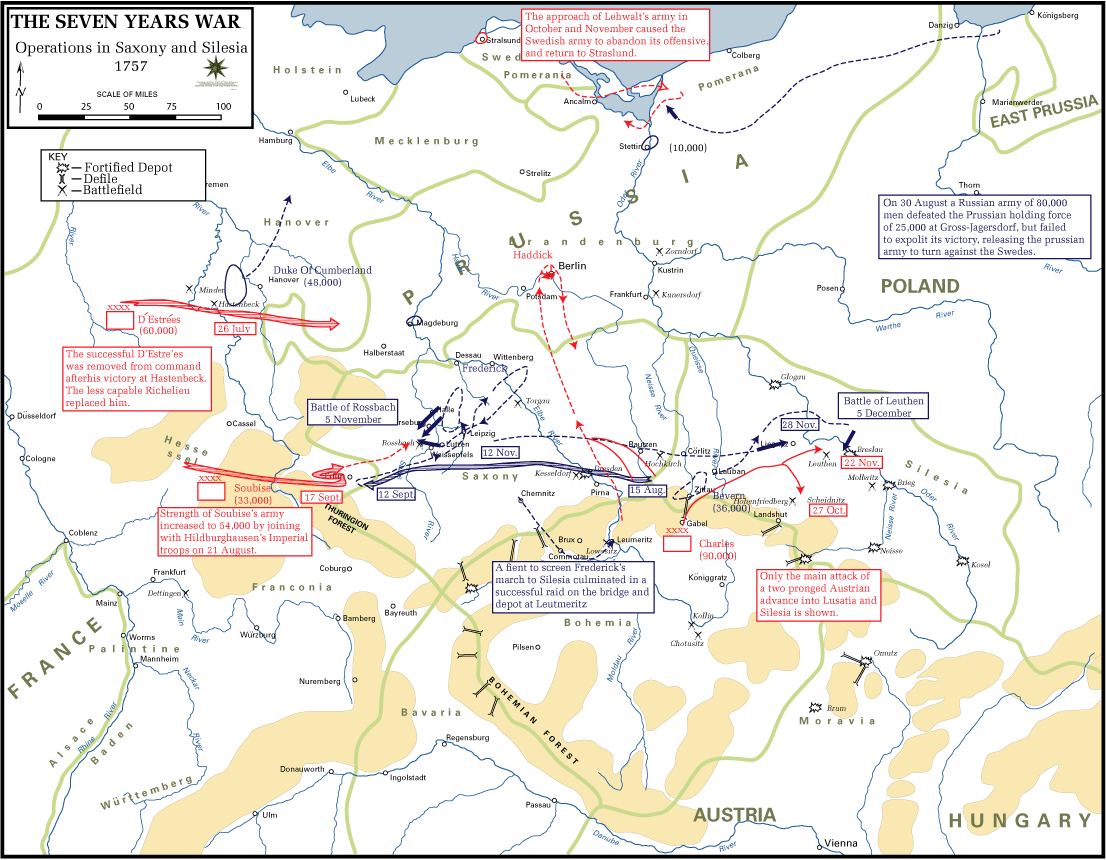
In most of these cases, Frederick was coming to the aid of local corps and garrisons: he arrived amidst an ongoing campaign, he did not initiate an entirely new one. So, while these strategic movements were much larger than any operational maneuvers, they occurred on a similar timescale—strategic and operational decision-making were tightly intertwined, in other words.
How different that was from the inter-theater movements of the First World War. Hundreds of thousands of men and their equipment had to be loaded onto trains and transported over a thousand kilometers between East Prussia and Galicia and France, then offloaded and moved to the appropriate position on the front. This was an enormous undertaking that could realistically be done only between the fighting seasons. Substantial transfers could only be effected in the course of a campaign when two independent strategic objectives existed in the same theater—as, for example, during the concurrent battles of the Somme and Verdun (smaller transfers, on the order of several divisions or corps, were made more frequently between the Eastern and Western Fronts).
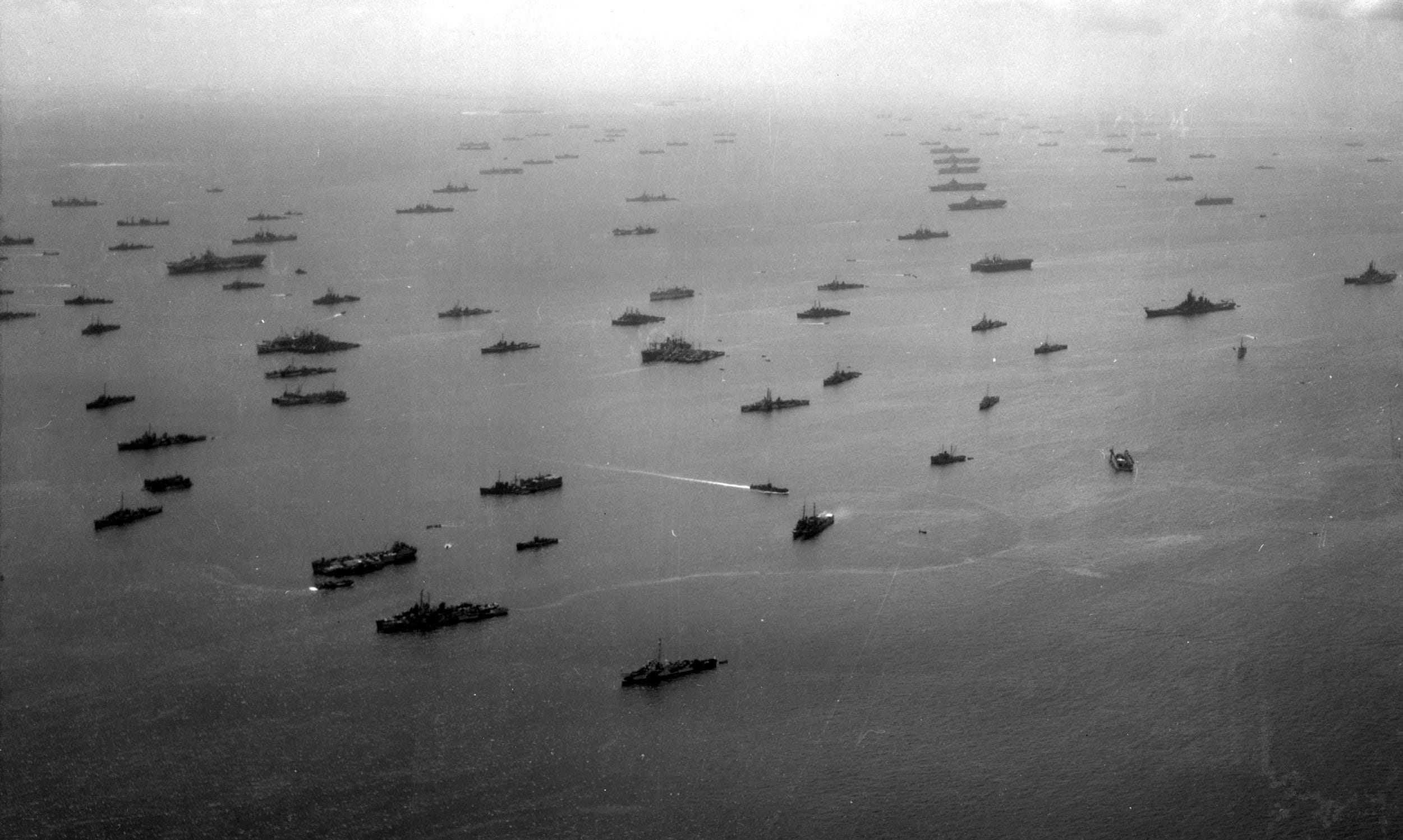
In the vast struggle of the Second World War, distances between the Atlantic and Pacific theaters were even greater. American strategists had to make their decisions about force commitments based on availability of ship types: carriers, cruisers, and amphibious ships were desperately needed in the Pacific, whereas transports and their escorts were needed in the Atlantic. This meant that strategic decisions were in some ways slowed to the speed of industrial policy. The nature of strategic decision-making, in other words, is not indifferent to scale.
The Fixed and the Fickle
As the centrality of defense production in WWII indicates, there is much that a strategist must contend with outside of military force alone. The intensive diplomacy of 18th-century coalitional wars, the mass mobilizations of the First World War, the shifting industrial targets of the Second, the fiscal and recruiting challenges of 16th- and 17th-century wars—all these constituted very different strategic problems.
But even when comparing strategic problems of a similar scope and scale, it is the variegated nature of the underlying political problem that shapes things the most. Slight wrinkles in the political landscape can completely upset calculations—something apparent when we look at multiple wars fought under very similar constraints, such as those induced by the particularities of a certain geography.
To use one obvious example, the modern state of Israel in the 20th century faced a similar situation to the Crusader Kingdom of Jerusalem and the Hasmonean kingdom before it. It was vulnerable to attacks via the Golan Heights and the Sinai Peninsula, and lacked much strategic depth to meet them. Yet none of the wars fought by any one of these states bears much resemblance to any other.
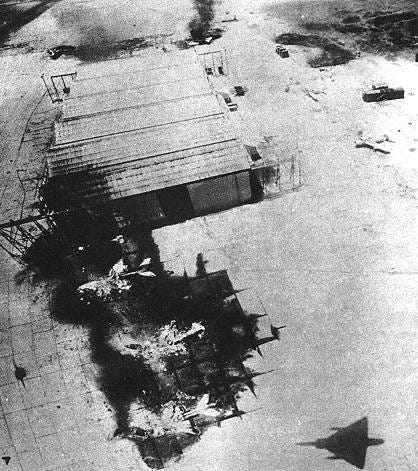
Even Israel’s wars don’t look like one another, as a result of a shifting political situation. The two closest are the Six Days’ War and the Yom Kippur War. The desperate situation leading up to the 1967 war caused Israel to launch a preemptive attack that ended in a stunning victory; that same victory made it politically impossible (either in the domestic or the international sense) to properly mobilize for the Arab attack in 1973.
Narrowing the Aperture
If it is impossible to study strategy in the abstract, if strategy itself encompasses a vast range of fields, then it is still at least possible to focus on one particular strategic problem. Studying a recurring geopolitical flashpoint, such as the Strait of Taiwan or the Strait of Hormuz, can be a useful starting point for decision-makers; but this carries the caveat that one must also be extremely sensitive to the subtle variations of political currents.
Strategists can also still learn from case studies. Even if the past does not serve as a template for present action, it can furnish a useful exercise: working through the similarities and differences between a past scenario and the present can help work through the subtler dynamics and draw out own’s own hidden assumptions. But as with anything relating to strategy, that requires deep thought and good judgment.
Thank you for reading the Bazaar of War. Most articles are free for all to read, but paid subscriptions are available to all who wish to support. Subscribers receive a pdf of the critical edition of the classic The Art of War in Italy: 1494-1529, and get exclusive access to monthly long-form pieces exploring selected topics in depth.
You can also support by purchasing Saladin the Strategist in paperback or Kindle format.