
This is the second installment on the Chickamauga Campaign, covering the maneuvers south of Chattanooga from 5 to 18 September 1863. The first installment examines the maneuvers to cross the Tennessee River from 16 August to 4 September; for the prologue to the campaign, see the separate piece on the Tullahoma Campaign.
As day dawned on 5 September 1863, Braxton Bragg remained curiously oblivious to the danger he was in. With Union forces massing southwest of Chattanooga, poised to sweep across his lines of communication and converge on the city, the commander of the Confederate Army of Tennessee was focused elsewhere. He believed that the enemy’s main thrust would come from the north, and that all activity to the south of his extended front was a secondary effort that he could easily parry.
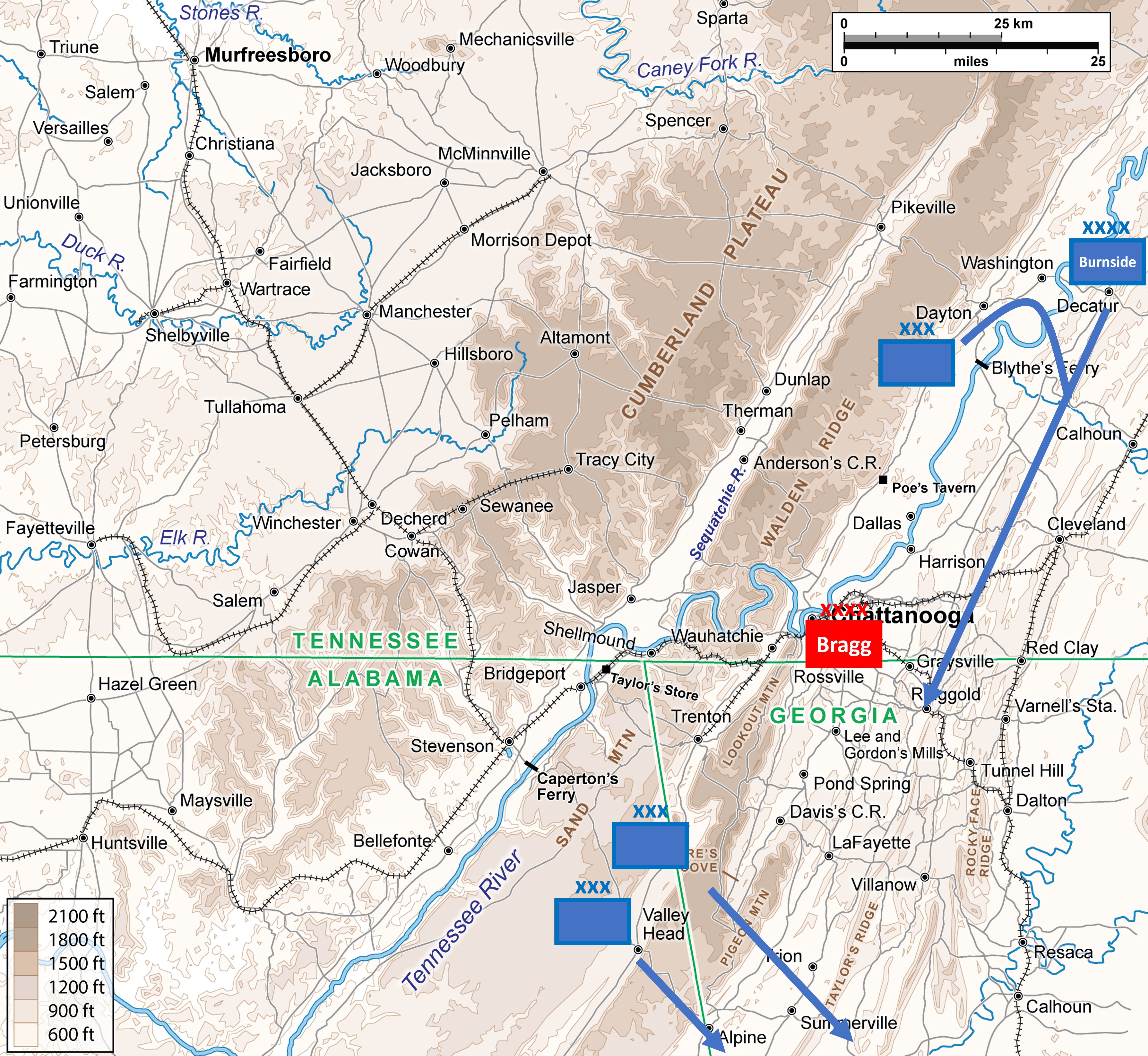
His views were supported by an article from the Chicago Times which Bragg forwarded to the War Department in Richmond that same day. It reported that William Rosecrans, commanding general of the Army of the Cumberland, had an entire corps north of the Tennessee River. He was said to be planning to push it across the river some 50 km upstream of Chattanooga, whereupon it would fall on the city from the rear.
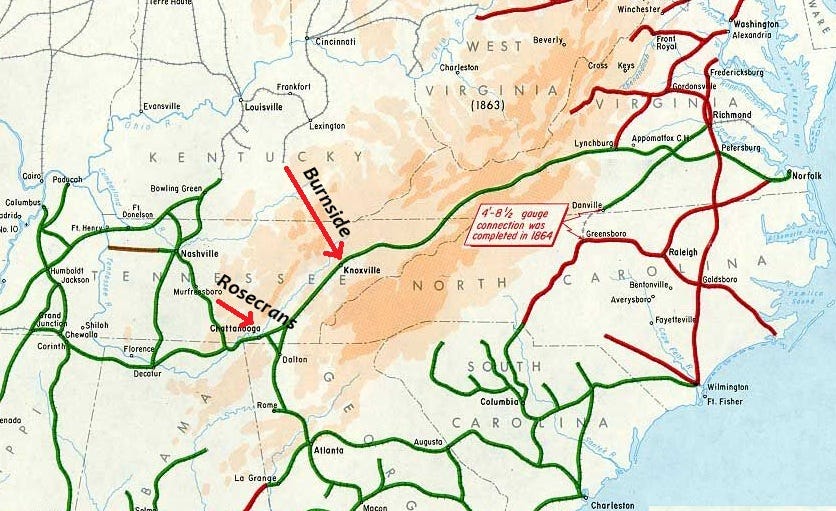
If this attack succeeded, another two corps would advance on Rome, Georgia—an important industrial center 90 km south of Chattanooga, just off the main Atlanta rail line—thereby threatening to cut off all supplies to the Army of Tennessee. Ambrose Burnside’s Army of the Ohio would meanwhile advance to Knoxville, 160 km northeast of Chattanooga, to prevent the forces in that city from reaching Bragg.
In view of this, everything seemed to be proceeding in Bragg’s favor. A corps of Burnside’s army had entered Knoxville just two days before, but its defenders had extricated themselves and joined Bragg’s army near Chattanooga, where they guarded his northern flank against the threatened Union hook. Bragg had received additional intelligence that Rosecrans planned to link up with Burnside for an advance on Chattanooga, and the Army of Tennessee was now concentrated around the city to meet the enemy with superior force.
Bragg was further aware that another two corps had crossed the Tennessee south of Chattanooga with designs on Rome, but was not acutely worried about that threat. Their objective was over 80 km from Union crossing points, requiring difficult ascents and descents of a series of parallel ridgelines. Advance elements had been spotted moving south through Will’s Valley: a much easier route, but one that extended the journey to some 200 km.
If anything, this presented an opportunity. Bragg had recently assigned a cavalry corps to picket the area and the day before had also sent a small infantry division to garrison Rome itself—more than enough to delay a Union advance. In the meantime, he resolved to go on the offensive himself. Taking the bulk of his army Chattanooga, he would cross the river and smash the lone corps opposite him, before turning south to deal with the rest of the enemy.
Yet Bragg’s intelligence was far less accurate than he realized. He had neglected to patrol his left flank until just days before, leaving him blind to several critical details that drastically altered the picture. All three Union infantry corps had in fact crossed the Tennessee south of Chattanooga and were positioned to close in on the city: what he believed to be a full corps north of the river was in fact a diversionary force of just four brigades. Although the Union army was indeed planning a concurrent move on Rome, this was left to the cavalry—more a destructive raid than a primary effort.
The Army of Tennessee was ill-prepared to meet this threat. The bulk of it was around Chattanooga itself and further upstream along the Tennessee, with only about 7,000 cavalry watching the long valley south of the city. This left Bragg completely off balance, unprepared to meet the blow headed his way. In short, the deception plan that Rosecrans had implemented since 16 August had been wildly successful.
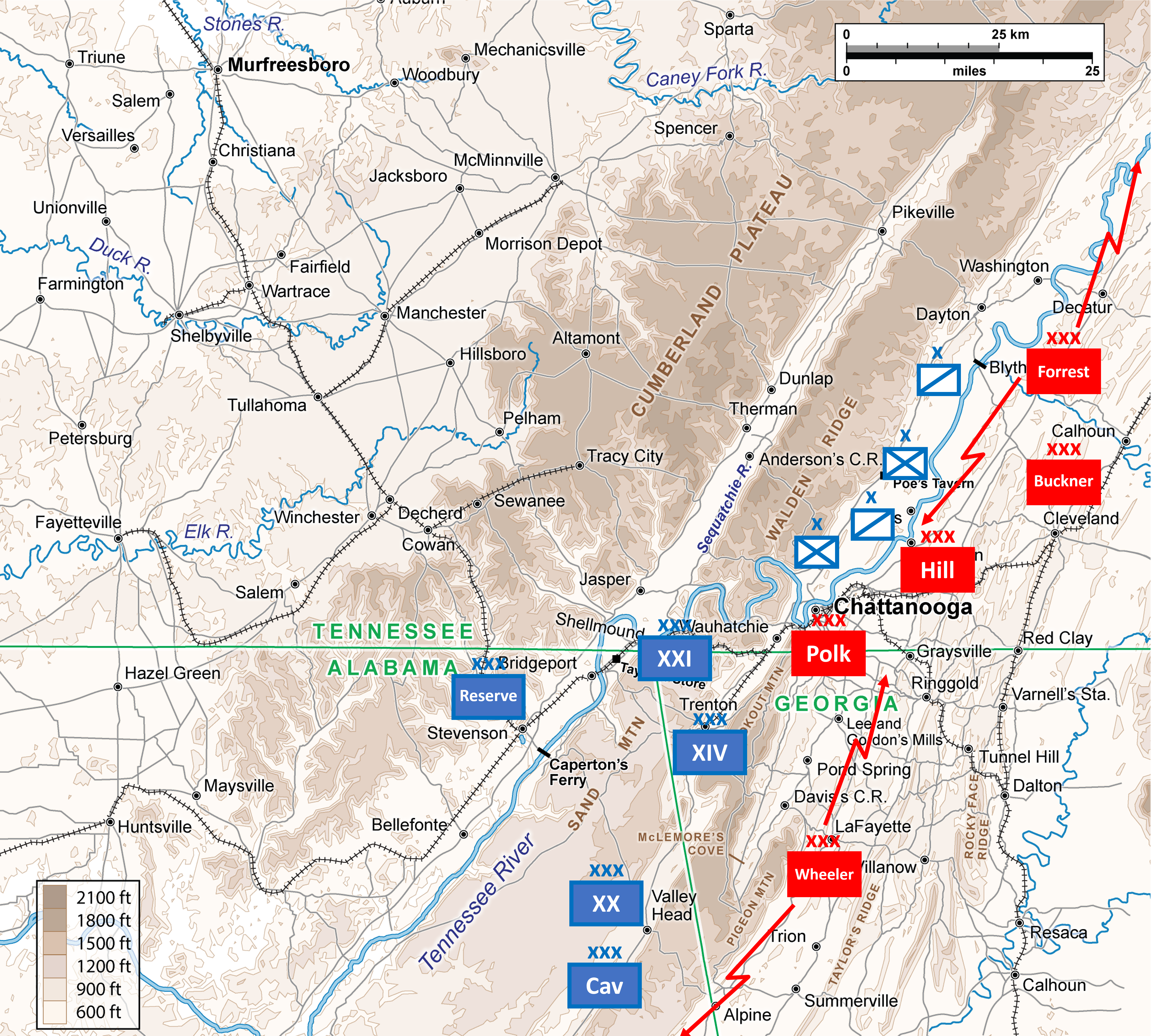
Bragg would soon realize his error, however, and withdraw from Chattanooga. This would reverse the position between the two commanders: by falling back on his lines of communication, he blinded Union forces to his true location and gave himself an advantageous position from which to strike out at his widely-dispersed foe. These dynamics would dominate the second half of the Chickamauga Campaign up until its culminating battle.
Operational Geography
It is worth briefly recapitulating the geography of southeastern Tennessee (described in more detail here). After crossing the Tennessee River south of Chattanooga, Union forces faced two more obstacles: the flat-topped Sand Mountain, followed by the steep Lookout Mountain. These long, parallel ridgelines extended southwest into Alabama and were separated by the narrow Will’s Valley (sometimes called Lookout Valley).
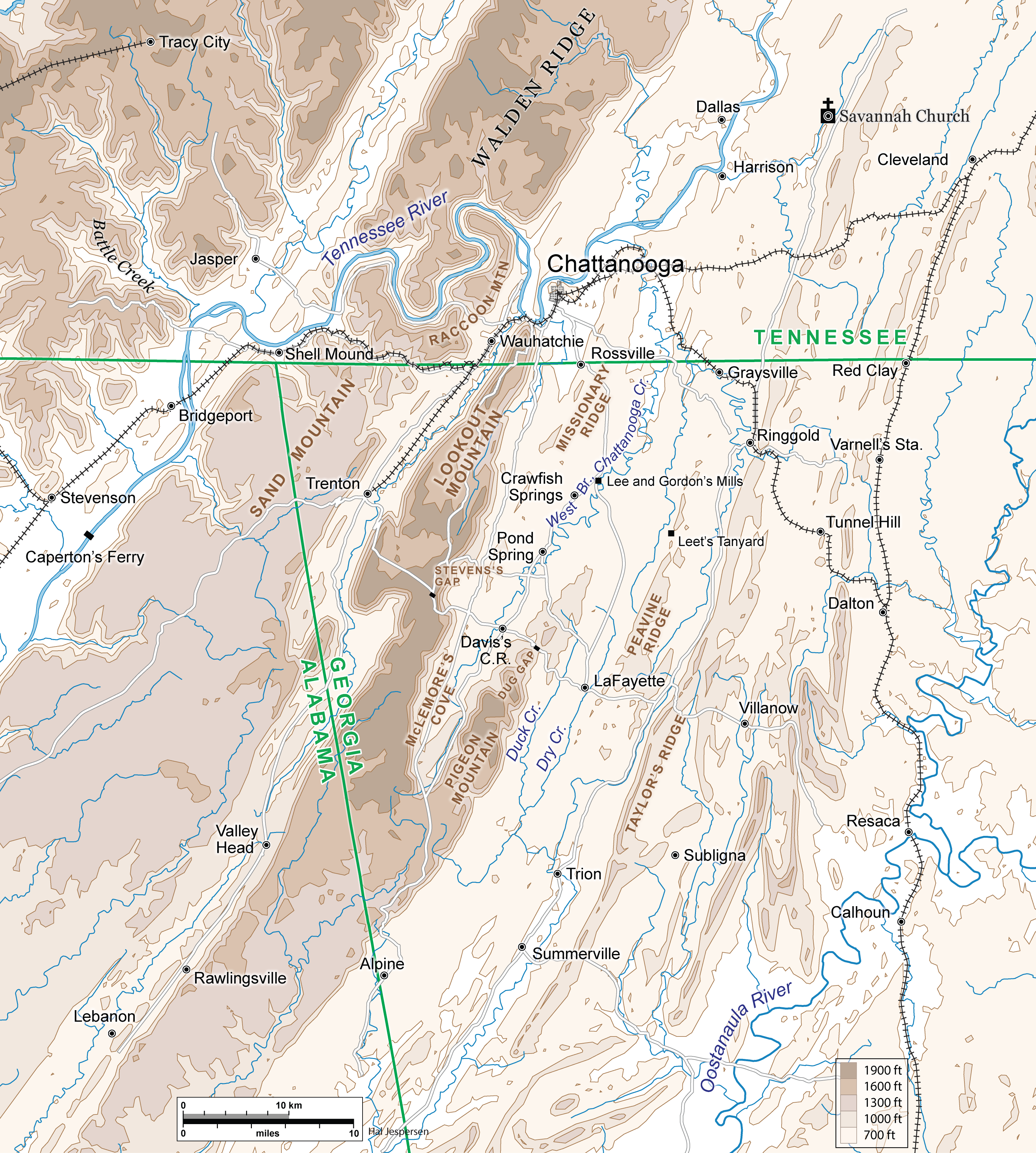
A fair distance beyond Lookout Mountain was a third major terrain feature, the shorter but no less steep Taylor Ridge. Together, the two ridgelines formed Broomtown Valley: a broad avenue that led directly to Chattanooga’s southeastern approaches. At the northern end of the valley, the Atlanta rail line cut through Taylor Ridge about 25 km southeast of Chattanooga. Several smaller ridgelines also ran parallel through the valley, partitioning it still further.
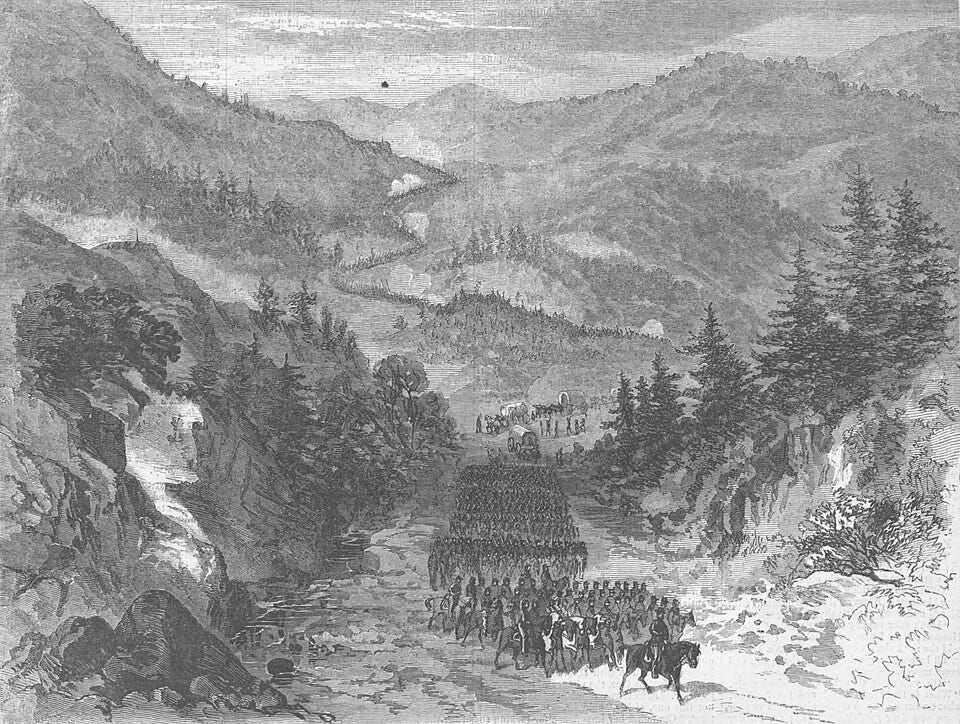
By 5 September, only Lookout Mountain stood between the two armies. This imposing terrain feature was to define the dynamics of the campaign over the next two weeks, masking the two armies from each other as they maneuvered for advantage. The crest itself was key terrain, a broad tableland nearly 15 km wide at points, defined by a sharp palisade on either side.
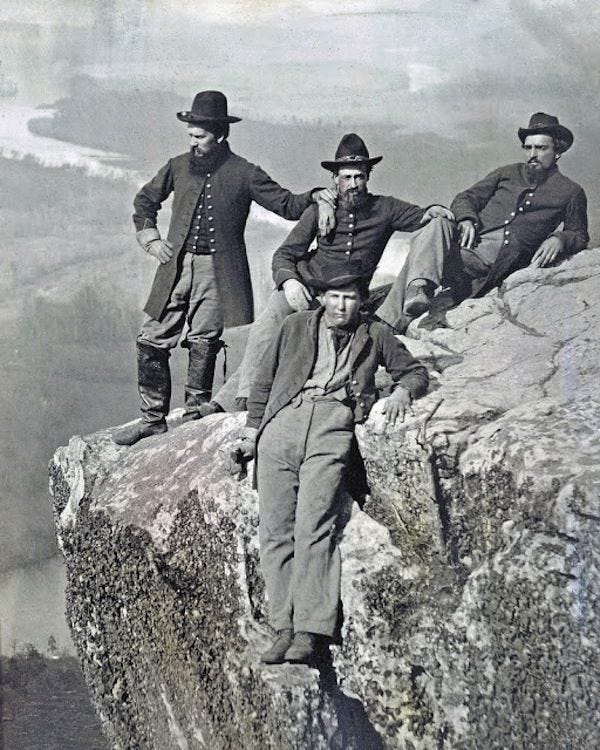
Although it was vital for the Army of the Cumberland to control the passes across, the heights brought no intelligence advantage: the hilly, wooded terrain of Broomtown Valley made it impossible to spy on enemy formations below—only the clouds of dust kicked up by large columns gave any sign of enemy presence, but of course indicated neither their composition nor the presence of static positions. This naturally put a premium on cavalry, the one arm that could provide timely intelligence as the two sides maneuvered across a 60-km front. Both commanding generals would be poorly served by their mounted arms, however, forcing them into a dangerous game of blind man’s bluff.
The Two Armies
The Army of the Cumberland had about 63,000 effectives in the immediate operational area. Over 50,000 infantry were organized into three corps—Thomas Crittenden’s XXI Corps, George Thomas’ XIV Corps, and Alexander McCook’s XX Corps—while 10,000 cavalry formed a two-division corps. Several brigades from the Reserve Corps, responsible for guarding the lines of communication back to Murfreesboro, were also close at hand, giving Rosecrans an additional 7,000 infantry he could call on.
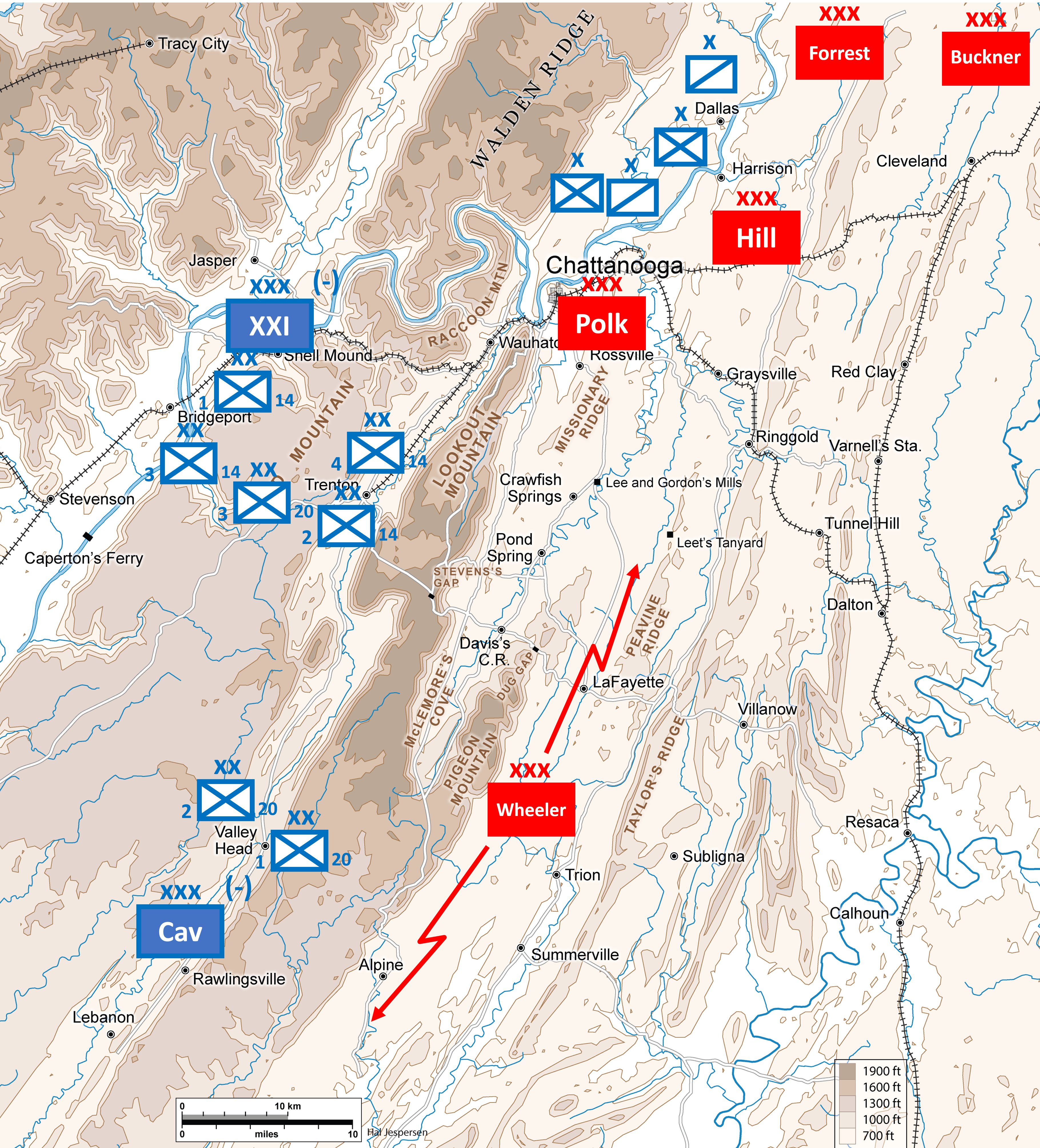
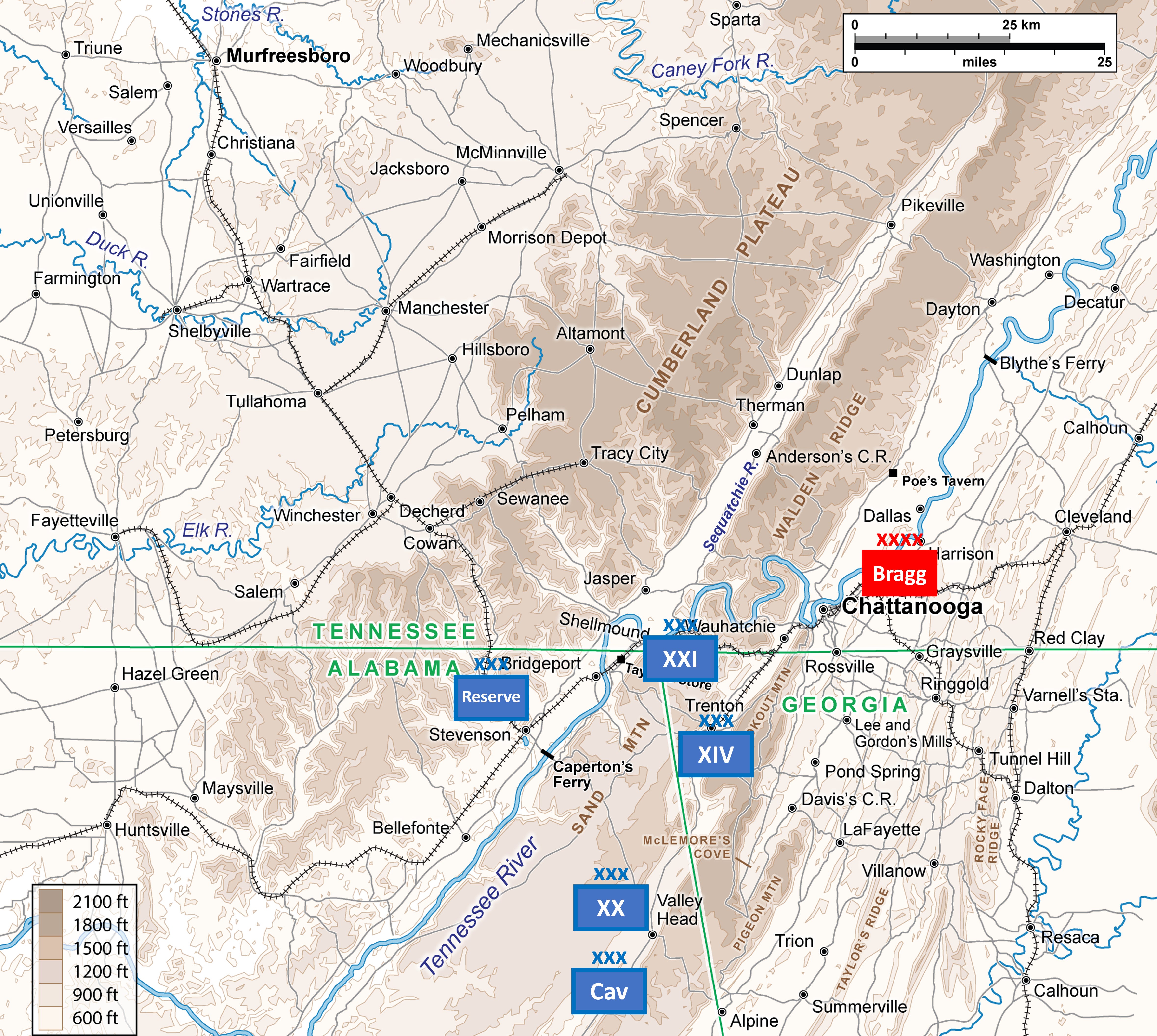
Nearly half this number had reached Will’s Valley by 5 September. Two divisions of XX Corps and both cavalry divisions were concentrated near Valley Head in the south, while XX Corps’ third division was still on Sand Mountain. Two divisions of XIV Corps had reached the vicinity of Trenton in the mid-valley, while its other two had yet to cross Sand Mountain. All three of XXI Corps’ divisions had consolidated at Shellmound, between the northern end of Sand Mountain and the river. Each division was light a brigade, detached for duties elsewhere.
The remainder of the army was north of the Tennessee River. The four brigades of the diversionary force occupied a long stretch of the riverbank opposite Chattanooga itself: two loaned from XXI Corps, Wilder’s mounted infantry from XIV Corps, and a brigade from the Cavalry Corps. The three divisions of the Reserve Corps guarded the lines of communication back into Middle Tennessee. 160 km northeast of Chattanooga, a corps of Ambrose Burnside’s Army of the Ohio occupied Knoxville, although it would play no role in the next phase of operations.
On the opposite side of Lookout Mountain, the Army of Tennessee totaled around 60,000 effectives, of which 16,000 were cavalry. Bragg had been restructuring the army as it absorbed reinforcements from elsewhere in the South, and its new organization closely mirrored the Union army: three infantry corps, a reserve corps, and two cavalry corps—the last of which reflected the Confederate advantage in that arm.
The infantry formed the army’s center. Leonidas Polk was concentrated around Chattanooga itself, D.H. Hill guarded the riverbank north of the city, and Simon Bolivar Buckner defended the Hiwassee River, a tributary of the Tennessee 50 km north of the city that cut across the approaches from Knoxville. Nathan Bedford Forrest’s cavalry corps screened the right flank, keeping an eye on Burnside’s forces, while Wheeler’s cavalry corps screened the left, with pickets on Lookout Mountain. A Reserve Corps was formed around this time under William Walker, tasked with guarding the rail line as far back as Rome, although the bulk of these troops were west of Taylor’s Ridge.
Bragg was soon to receive substantial reinforcements to deal with these disparate threats. On 5 September, Confederate president Jefferson Davis approved the transfer of most of James Longstreet’s corps from the Army of Northern Virginia to the Army of Tennessee. He would bring with him two divisions and his artillery, about 12,000 troops in all. These troops would take some time to arrive—the Union capture of Knoxville had cut the most direct rail line, forcing Longstreet to take a much more circuitous route involving several transfers between trains of differing gauges. But the knowledge that he would soon enjoy a meaningful numerical advantage undoubtedly figured into Bragg’s calculations in this phase of the campaign.
Order of Battle
The following is the order of battle from just before the evacuation of Chattanooga, when Bragg reorganized his army, until the Battle of Chickamauga and the arrival of Longstreet’s Corps. Corps are listed from north to south per initial dispositions.
Army of the Cumberland (William Rosecrans)
Diversionary brigades: 2 from XXI Corps, 1 from XIV Corps (mounted infantry), 1 cavalry
XXI Corps (Thomas Crittenden): 3 divisions, 9 brigades (6 on hand)
XIV Corps (George Thomas): 4 divisions, 12 brigades (11 on hand)
XX Corps (Alexander McCook): 3 divisions, 9 brigades
Cavalry Corps (David Stanley): 2 divisions, 5 brigades (4 on hand)
Reserve Corps (Gordon Granger) in the rear: 3 divisions (3 brigades in the area)
Army of Tennessee (Braxton Bragg)
Nathan Bedford Forrest’s Cavalry Corps: 2 divisions, 4 brigades
Simon Bolivar Buckner’s Corps: 2 divisions, 7 brigades
D.H. Hill’s Corps: 2 divisions, 6 brigades
Leonidas Polk’s Corps: 2 divisions, 8 brigades
Joseph Wheeler’s Cavalry Corps: 2 divisions, 4 brigades
William Walker’s Reserve Corps in the rear: 2 divisions, 5 brigades
Union Concept of Operations
In truth, Bragg need not have worried about Burnside’s men. The Army of the Ohio had trudged over difficult mountain roads to reach Knoxville, which was not supplied by any railroad from Union territory. This limited its operational reach to the immediate vicinity, where it skirmished with those parts of Buckner’s command that had remained northeast of the city. For the time being, Bragg and Rosecrans were therefore closely matched in strength.
Rosecrans’ one great advantage was position. His diversionary brigades north of the river passed him very reliable intelligence that most of the Army of Tennessee remained concentrated to the north. With Bragg so far off balance, he had an excellent opportunity to threaten Bragg’s lines of communication.
Yet even this would not be so easy to exploit. Ideally, he would sweep across with his entire army and trap the Army of Tennessee in Chattanooga. But the rugged terrain of northwestern Georgia and southeastern Tennessee—a hindrance to both sides—posed on balance a greater problem for the attacker, which faced the additional challenge of crossing Lookout Mountain. Its steep ridgeline was only accessible at a handful of passes, involving difficult ascents and descents; moving an entire corps to the far side with its attendant wagon train would take roughly two days, making it a far tighter bottleneck than the Tennessee River crossings.
This timetable meant that the Confederates would inevitably have plenty of forewarning, while the tight bottlenecks meant that Rosecrans had no choice but to concentrate the Army of the Cumberland on the far side of Lookout Mountain; this in turn posed a difficult challenge of timing. It would be a great risk to move his dispersed columns into Broomtown Valley while Bragg was nearby, so he had to simultaneously compel his adversary to abandon the city. This was the evident logic of the plan Bragg had gleaned from local spies and Northern newspapers: a thrust toward Rome to threaten his communications.
A mere cavalry raid would be insufficient in itself, so Rosecrans had to add weight to the threat by simultaneously moving his two southern corps across the mountain. XXI Corps would meanwhile threaten Chattanooga from the west; with luck, this would be sufficient to compel Bragg to retreat southeast along the railroad.
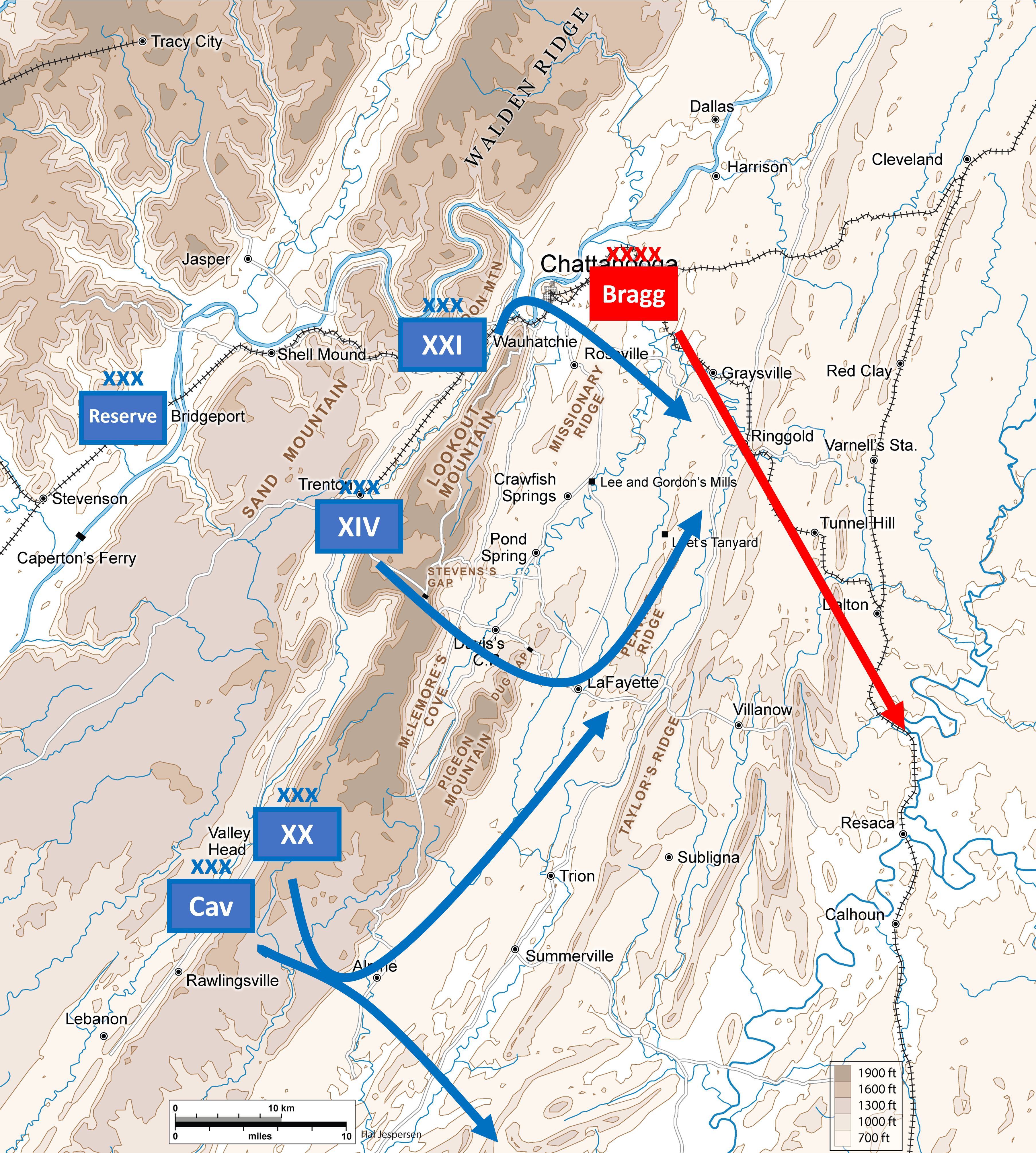
The plan certainly entailed great risks. The imposing obstacle of Lookout Mountain made crossing it an all-or-nothing affair: each corps had to bring its baggage train along, which made it hard to backtrack. They would moreover be going in blind to the folded and tree-covered terrain of Broomtown Valley, without any nearby help if they ran into trouble. Their isolation was amplified by slow communications—signaling stations had not yet been established nor telegraph wire laid, limiting messages to hours-long courier routes.
Rosecrans had accomplished a great coup in the first half of the campaign by getting his entire army south of the river, and he was in as good a position as he could hope for. There was no getting around the fundamental geographic difficulties that lay ahead, however, and advancing required a roll of the dice. The fate of the campaign would come down to timing and luck.
Levering Bragg Out of Chattanooga
Rosecrans’ immediate priority was to get the Army of the Cumberland on line in Will’s Valley. Only XX Corps and the Cavalry Corps in the south were close to being fully concentrated, and it was important to keep Bragg’s attention to the north while the rest of the army began moving over Lookout Mountain. XXI Corps’ northern-most division would advance along the rail line as far as Wauhatchie, just 7 km SW of Chattanooga, while the rest of the corps occupied a line further south.
Once XXI Corps was in place, lateral communications through the valley would mitigate some of the initial coordination problems across such a wide front. Although it was a total of 50 km between Wauhatchie and Valley Head, communications would be aided by a rail spur extending 20 km off the main line from Wauhatchie to Trenton. The Signal Corps meanwhile busied itself laying telegraph wire to Trenton, which was to be army HQ during the advance, and establishing signaling stations to communicate with outlying corps.
While the army’s left flank moved into place, the cavalry was to strike toward Rome—either by looping south through Will’s Valley and then east, or by crossing directly over Lookout Mountain. XIV and XX Corps would begin pushing over the ridgeline soon after, aiming to add credibility to the threat.
5 September
XXI Corps spent the morning waiting for its supply train to cross the river then set off in the afternoon. First Division took the lead, advancing along the railroad through a narrow pass in Sand Mountain toward Wauhatchie, with the aim of opening direct lateral communications with XIV Corps. The division only made it halfway across the mountain by nightfall, and the entire corps encamped in the gorge that night.
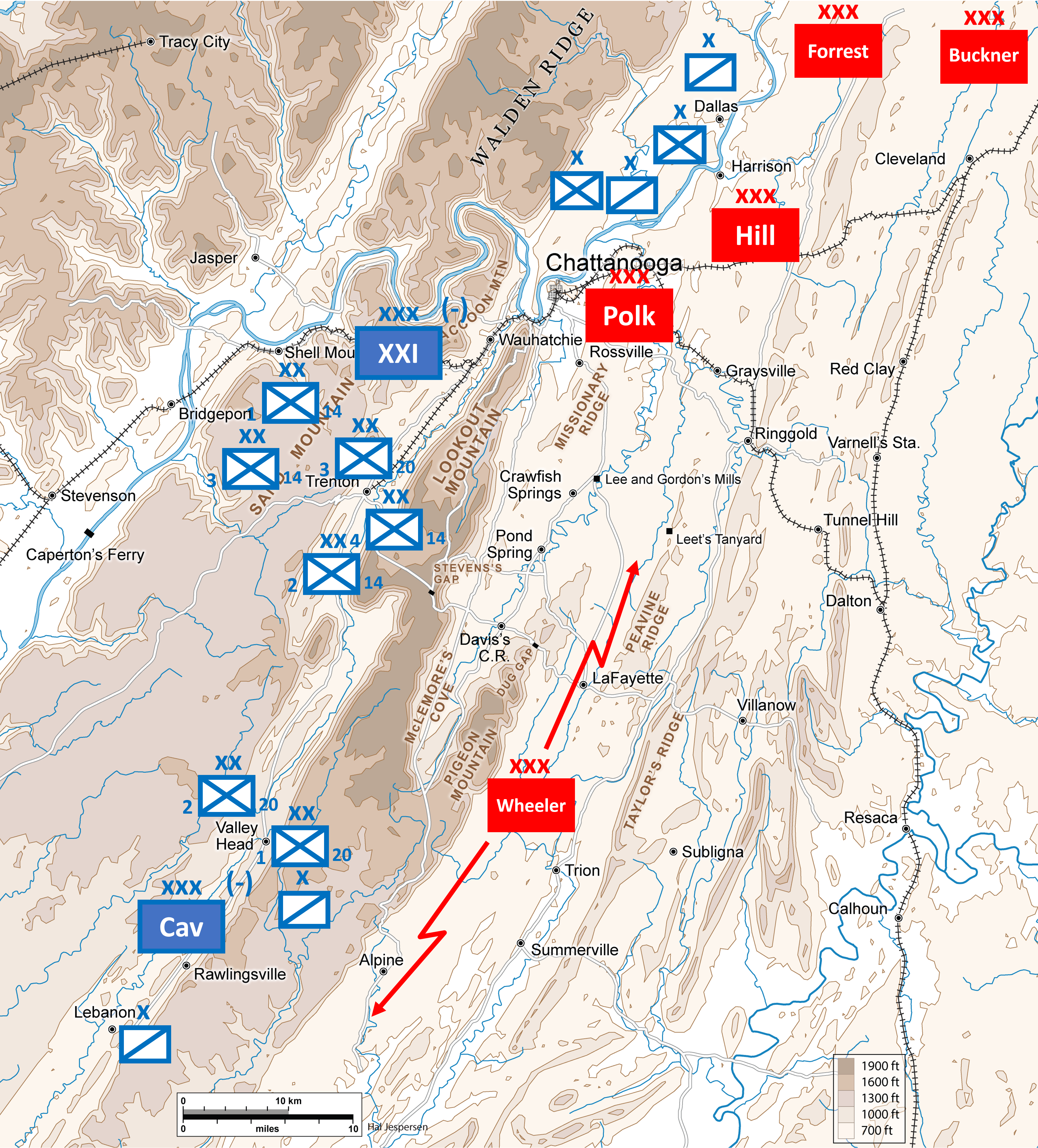
In the center, two divisions of XIV Corps converged in and to the south of Trenton. They were joined by a division from XX Corps that descended Sand Mountain that day, while the other two XIV Corps divisions began climbing Sand Mountain. With these last two divisions departing the Tennessee River bridgeheads, Rosecrans ordered the Reserve Corps to push elements forward and guard the crossings at Caperton’s Ferry and Bridgeport.
Further south in Will’s Valley, the rest of XX Corps remained idle around Valley Head; the Cavalry Corps, also at Valley Head, was more active. A brigade drove Rebel patrols past Rawlingsville, 10 km to the south, then continued past Lebanon, another 20 km to the south. Another brigade drove off some pickets on top of Lookout Mountain and scouted into Broomtown Valley beyond, where it spotted a Confederate brigade at Alpine; no other enemy troops were detected in the area.
In the Confederate camp, Bragg was beginning to grow uneasy. The previous day, he himself had expressed misgivings about his plan to strike across the Tennessee. He acknowledged that any crossing at Chattanooga would be covered by Yankee guns and that it would take considerable effort to cross further upstream. Forrest had promised to carry the infantry across on horseback at suitable fords, but that did not solve the problem of the artillery—one divisional commander pointed out the necessity of bringing guns against a full corps that had had time to dig in.
Other developments also gave Bragg cause for concern. Wheeler reported that Union forces in Will’s Valley were steadily increasing and had reached corps strength—there had been an estimated division just the day before—while that day’s clashes on Lookout Mountain led the commanding general to suspect that something else was afoot. One other factor must have troubled Bragg: if Union forces across the river were indeed planning to link up with Burnside farther upriver, as his own intelligence reported, why was there no sign of movement from either corps?
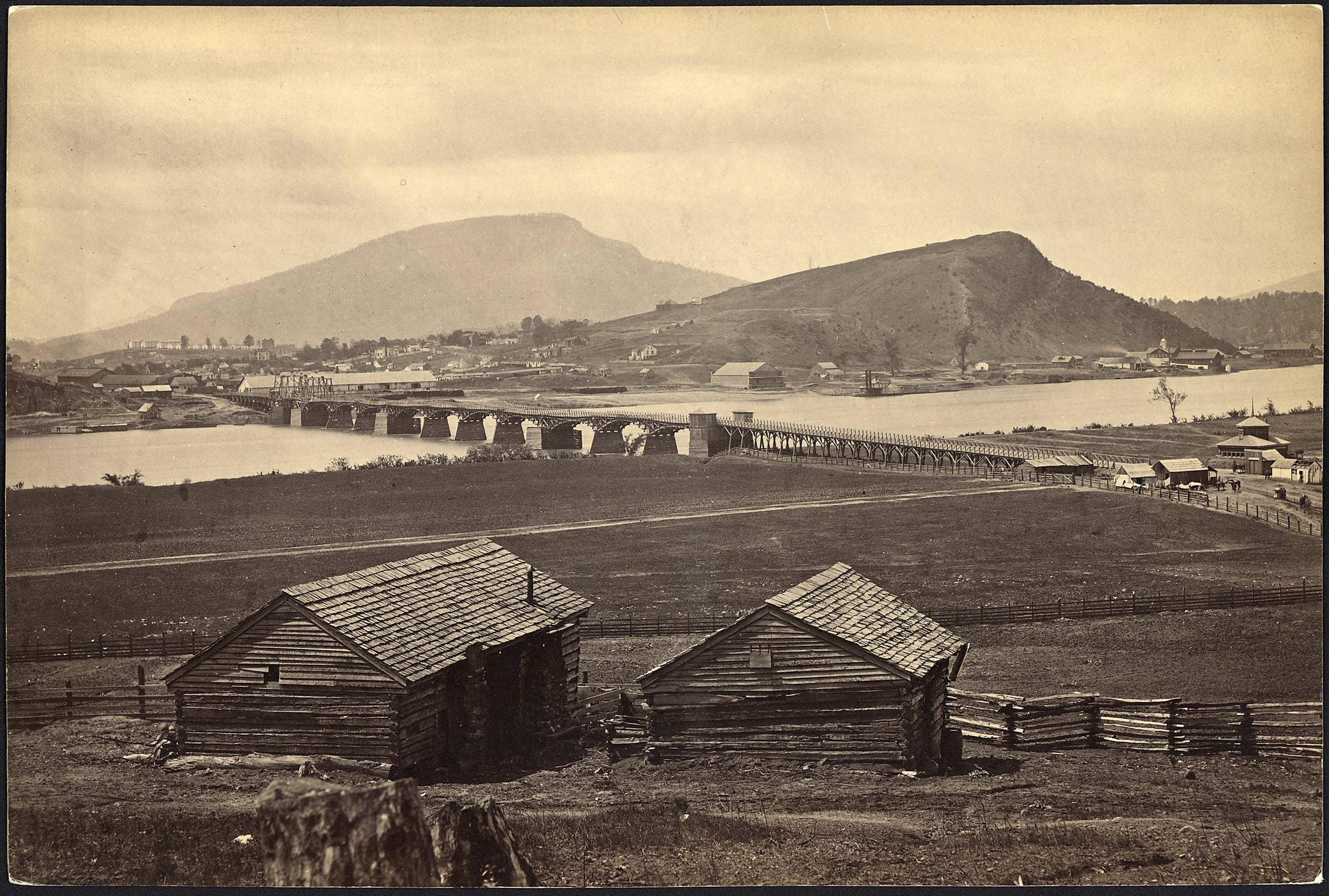
Nevertheless, the Army of Tennessee continued to move forward with preparations. Rosecrans’ diversionary force observed Confederate engineers preparing to swing a pontoon bridge across from Chattanooga and large clouds of dust from troop movements further north. But in the meantime, Bragg ordered Wheeler to lead his command into Will’s Valley to develop his understanding of enemy dispositions. This was to be top priority, to be accomplished even at the risk of casualties.
6 September
Union forces continued to come on line in Will’s Valley. In the north, First Division XXI Corps resumed its northeastward march while the corps’ other two divisions hooked southeast, their forward elements reaching a point 7 km north of Trenton to join with XIV Corps’ left. First Division drove back Confederate skirmishers and reached Wauhatchie, where it noted enemy positions on Lookout Mountain and witnessed signalers passing news of its approach. This made the division commander nervous: without any friendly units close at hand, he would be dangerously exposed if faced with a counterattack. He pulled back to better ground 2.5 km to his rear, and Crittenden advised him to withdraw in the direction of Trenton if a counterattack materialized.
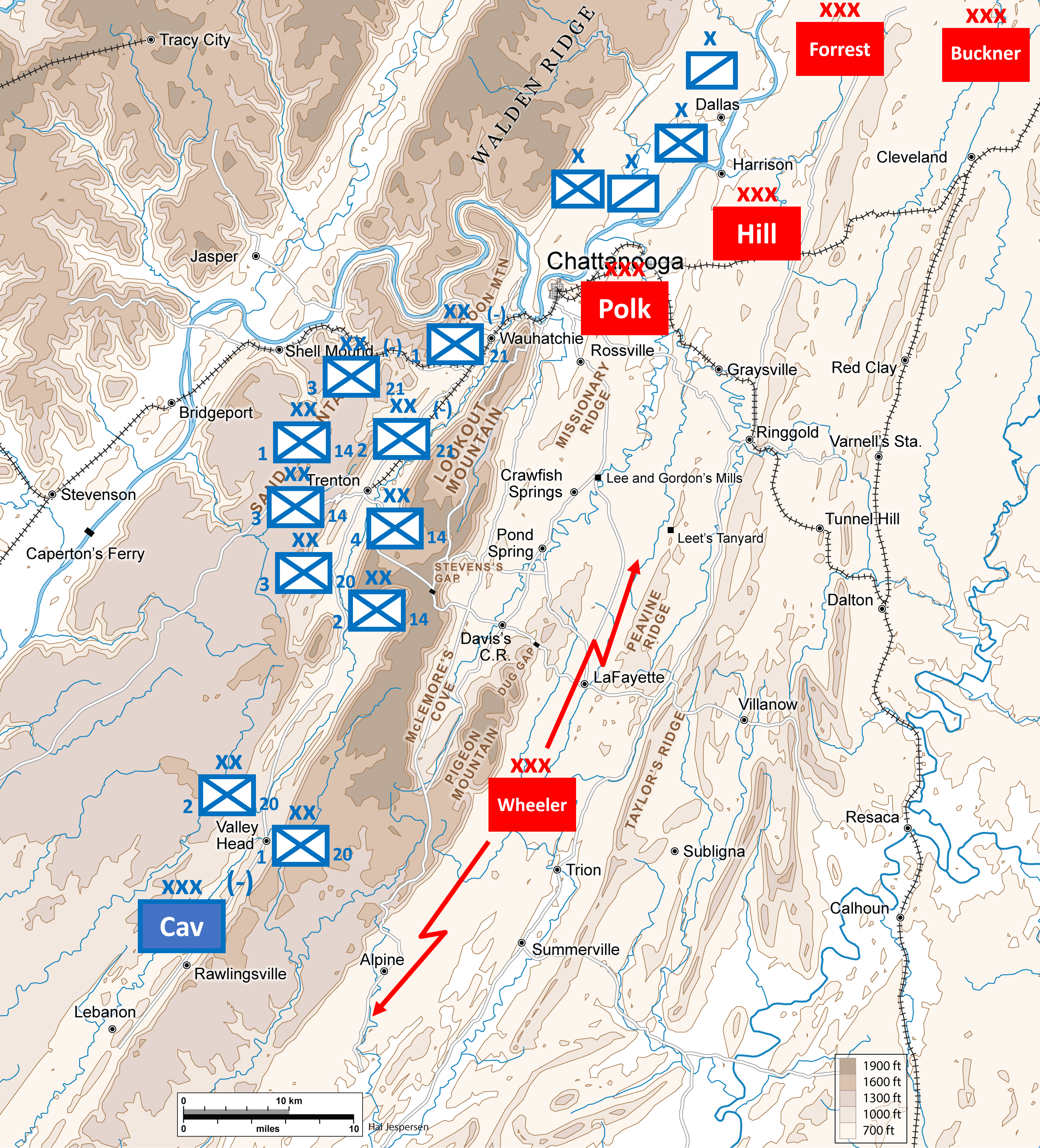
In the center, XIV Corps began to push forward even before it consolidated. Second Division marched to the foot of a gap near Trenton and sent a regiment to scout ahead, revealing enemy pickets near the peak. The two lagging divisions continued their march across Sand Mountain, with the lead elements of one reaching Trenton. Third Division XX Corps meanwhile disentangled itself from XIV Corps and marched 8 km south from Trenton to rejoin the rest of its parent corps. Rosecrans himself arrived at Trenton and made his headquarters there.
XX Corps and the cavalry were not especially active except for some skirmishing on Lookout Mountain. Although First Cavalry Division’s supply trains came up that day, Stanley wrote to Rosecrans expressing his reluctance to advance any further. He was down a brigade (Robert Minty’s Brigade, detached to the diversionary force), and was being pulled in multiple directions: tasked not only with reconnoitering Lookout Mountain and Will’s Valley, but also with maintaining communications with the rest of the army. Finally, he learned that the three brigades of First Cavalry Division did not have the equipment on hand to tear up the train tracks around Rome.
Stanley was coming down with an incapacitating illness which caused him on 15 September to relinquish his command—this doubtlessly affected his willingness to move aggressively. After the war, he also expressed disagreement with Rosecrans’ employment of the cavalry. This was perhaps informed by the experience of the mounted infantry earlier that year. The entirety of Streight’s Brigade had been captured that spring when sent on a deep raid against Rome, and even Wilder’s Brigade had not been especially effective in an operational role when sent across the Elk River during the Tullahoma Campaign—it inflicted only minimal damage to the railroad and itself only narrowly escaped capture.
By contrast, cavalry and mounted infantry alike saw much greater success when acting in close cooperation with the infantry. Wilder’s Brigade and a mounted infantry regiment had helped capture two gaps during the Tullahoma Campaign, but they only held those positions because their parent corps followed close behind. A few days later, Union cavalry drove Polk’s Corps out of Shelbyville with the assistance of a Reserve Corps division, harrying the Confederate rear to great effect. Stanley therefore preferred a more tactical role for his men, scouting, screening, and harassing the enemy. For a combination reasons, Rosecrans was therefore unsuccessful in urging the cavalry forward over the next few days.
On the other side of Lookout Mountain, Bragg was having troubles of his own getting his cavalry to move. Wheeler addressed a long dispatch to the commanding general explaining why it was impossible to reconnoiter Will’s Valley firsthand. He had already blocked many of the passes with felled trees, making both advance and retreat hazardous; with the enemy’s strength at Valley Head at least a corps, that would make any reconnaissance exceedingly dangerous. Instead, he averred he could properly observe their activity from the heights of Lookout Mountain but made no mention of probing Union concentrations further north in the valley.
More usefully, a Georgia home guard scout reported to army headquarters that he had counted 71 pieces of artillery the Union was bringing down Sand Mountain a few days before. This represented over a third of Rosecrans’ total artillery park, and more had undoubtedly been brought since then. Combined with other unsettling developments over the previous few days, it was clear that this activity in the south represented Rosecrans’ main effort. Bragg knew he would have to abandon Chattanooga.
That evening he issued marching orders, to be executed the following morning. The army would not follow the railroad through the narrow Ringgold Gap, but would instead march south through the wide Broomtown Valley, where two parallel roads offered less congestion. Walker’s Reserve Corps would lead the eastern column, followed by the army’s wagon train and Buckner’s Corps in the rear. It would march to a point near LaFayette, then cross Taylor’s Ridge and continue south along the eastern slope to a point opposite Summerville. Polk and Hill’s Corps would march with the reserve artillery along the western road, screened to the front and rear by Forrest’s cavalry—marching closest to Lookout Mountain, they were more likely to make enemy contact. Their orders were to travel via LaFayette to Summerville.
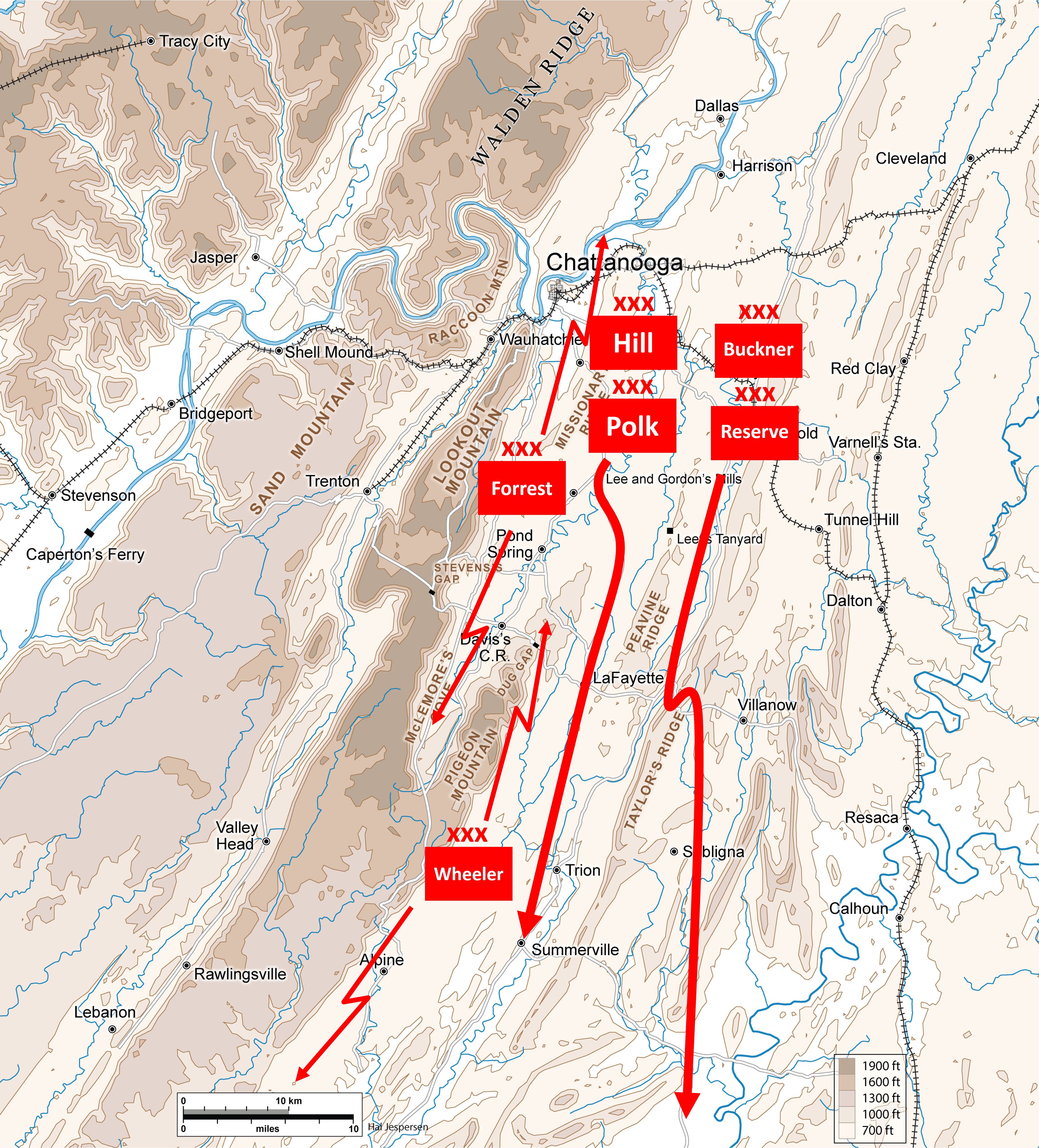
It was much harder to supply the Confederate army in Broomtown Valley, which was not served by a rail line, but it put Bragg in a strong position where he could plot his next move. Summerville controlled two roads to Rome: a pass over Taylor Ridge to its east and another that continued south through the valley. His cavalry, artillery, and half his infantry would be facing the enemy, while his train would be safe behind Taylor Ridge—depending on Rosecrans’ actions, he could either fight a battle there, pushing Buckner and Walker’s corps forward as needed, or cover a continued retreat toward Rome.
Bragg wanted to concentrate as many troops as he could around Rome, and requested additional reinforcements from Mississippi to be sent to Atlanta to free up the troops guarding the city. This requested was grudgingly approved, and two small brigades—about 2,500 in all—were ordered that day to march east as a temporary loan.
7 September
The Army of Tennessee did not set off at the appointed time. Having just been preparing its thrust to the north, it was in no position to march immediately in the opposite direction, and the ever-indecisive Bragg soon had second thoughts. A staff officer who had been present with the cavalry at Alpine asserted that the move on the Yankee right was just a feint, and both Polk and Hill advocated remaining in Chattanooga; but after several hours of deliberation, Bragg made up his mind and ordered the army to begin moving after dark.
The Army of the Cumberland did not make any bold moves either. First Division XXI Corps sent a brigade forward to reconnoiter Confederate positions while its two sister divisions remained north of Trenton. Most of XIV Corps concentrated around Trenton, and Third Division XX Corps continued moving south; the rest of XX Corps and the cavalry would not advance, and remained stationary at Valley Head. Of the entire army, only Second Division XIV Corps made a bold advance: its vanguard outflanked the defenders at the gap, allowing the entire division to get atop Lookout Mountain.
8 September
XXI Corps’ Second and Third Divisions marched a few kilometers north to support First, whose commander feared an imminent attack out of Chattanooga. Scouts instead detected commotion within the Confederate camp that suggested an imminent withdrawal, so Second and Third Divisions were each ordered to send a brigade up Lookout Mountain in the early morning hours the next day, while First Division stood ready to conduct a reconnaissance in force around the northern tip.
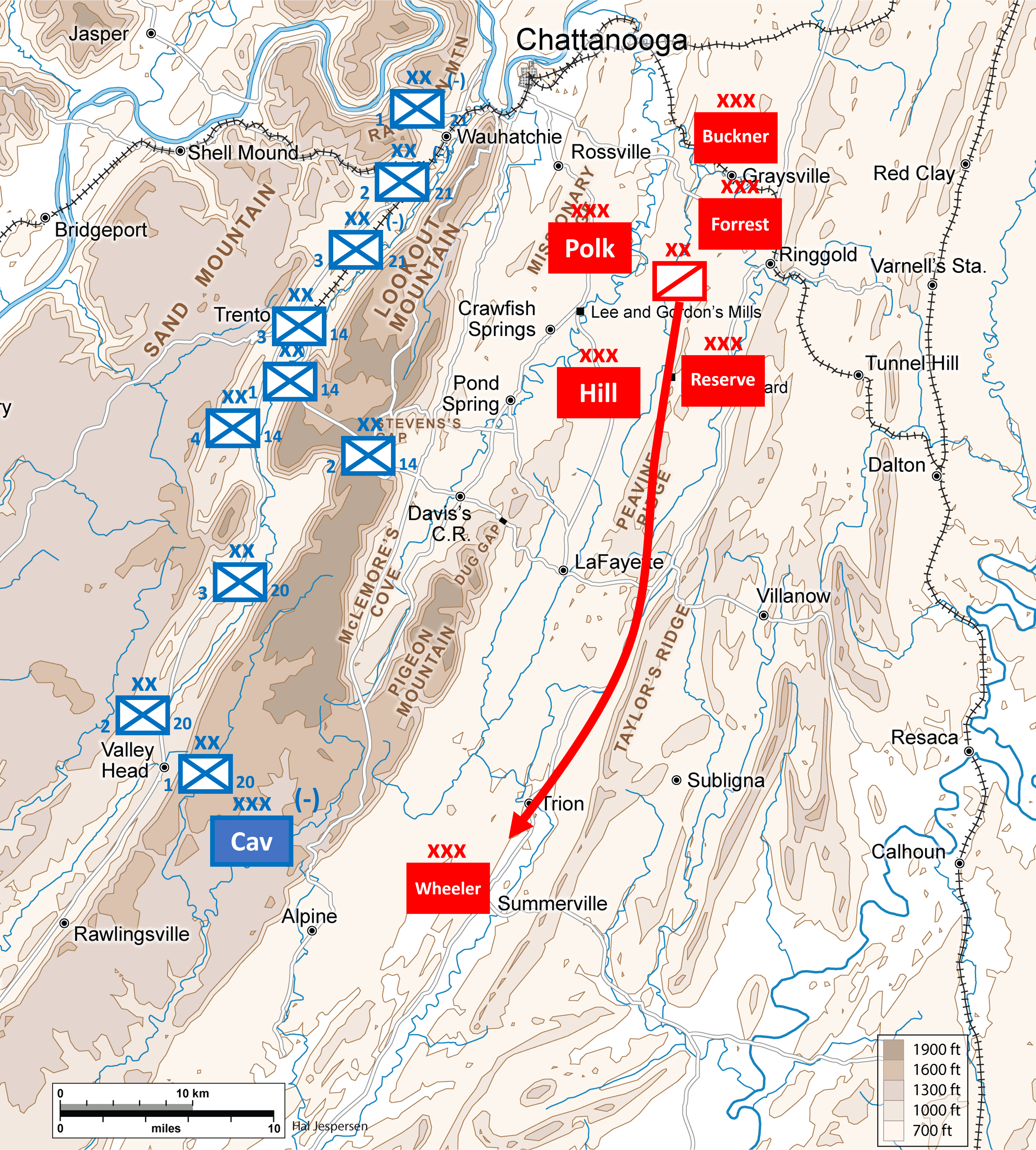
Farther south, the rest of the Army of the Cumberland began its passage across Lookout Mountain. In the center, Second Division XIV Corps seized Stevens’ Gap on the far side, while First Division moved up to the foot of the mountain to prepare its own ascent. On the right, the Cavalry Corps finally set in motion, ascending Lookout Mountain that evening to take possession of the gaps on the far side. First Division XX Corps sent two brigades in support, leaving one behind to guard the baggage. Third Division remained between Trenton and Valley head, linking the right flank with the rest of the army.
On the other side of the mountain, the entire Confederate host was in motion. The march largely followed Bragg’s original orders, although the threat in the south convinced him he needed more cavalry there. Forrest left one division to guard the railroad near Ringgold then raced with his other to Summerville, where Wheeler’s Corps informed him that some Union troops had been spotted at Alpine, just 13 km away.
Far away in northern Virginia, other Confederate movements would have a major impact on the maneuvering in the valleys of northern Georgia. Two divisions of Longstreet’s Corps departed Lee’s army that day to join Bragg. Knoxville’s capture at the beginning of the month had already severed the direct line to Chattanooga, forcing them to take a route more than twice the total distance, made all the longer by the numerous transfers across the rickety Confederate rail network. Burnside’s offensive succeeded in delaying their arrival, but the effect would not last forever.