
Below is a synopsis and discussion of David Chaffetz’s Raiders, Rulers, and Traders: The Horse and the Rise of Empires. This book is really valuable for understanding Eurasian military history, as it describes geopolitical dynamics from the perspective of the horse trade and the ability of states to mount their armies. You can find other book discussions here.

Synopsis
Raiders, Rulers, and Traders covers the relationship between horses and human society, tracing the story from the domestication of the horse through the 20th century. Chapter 1 begin with mankind’s earliest relationship with horses: first hunting them for food, then around 5,000 years ago herding them for milk and slaughter. This opened up the grasslands of the Eurasian steppe—land not suited to farming—to settlement by pastoralists. Chapter 2 looks at the first uses of horses in war: not as cavalry, but to pull chariots. Although humans probably rode horses before then, horses were still too small to be ridden in combat and had not yet been bred to respond to human guidance. What started out as cumbersome carts evolved into lighter and faster chariots, with sophisticated tack for controlling the horses. Sedentary states in contact with the steppe began acquiring them in the Bronze Age, and charioteers formed a social and military elite that upheld these centralized monarchies.
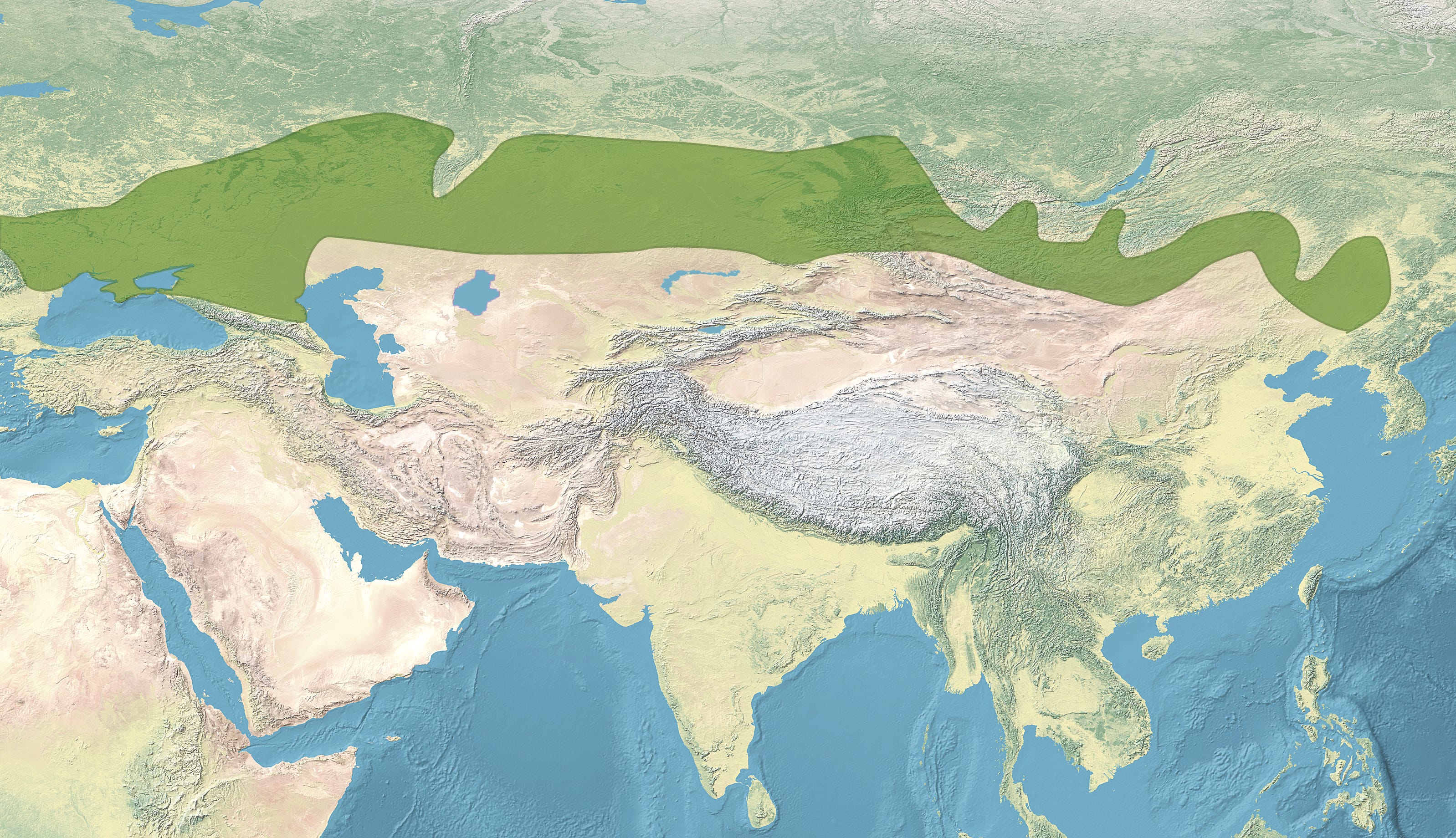
In the period 1800-1200 BC, horses were bred to be larger and stronger. This eventually allowed the rise of true cavalry among the Scythians and other steppe peoples, which terrorized their settled neighbors in the first millennium BC. The next two chapters cover how those neighbors’ adoption of cavalry formed the basis of large Asian empires—beginning with the Persians and Indians in Chapter 3. Steppe societies could grow massive herds on unlimited grasslands, but had trouble feeding them on campaign elsewhere; Achaemenid Persia, by contrast, used its massive wealth to organize a complex logistical system to feed their mounts alfalfa on campaign. The soil in India is less conducive to raising horses, but wealthy dynasties starting with the Nandas and Mauryas purchased mounts from the more suitable Punjab grasslands and maintained them with expensive diets (alongside their gluttonous elephant corps).
Han China, which Chaffetz discusses in Chapter 4, was a bit of a different case. Like India, the soil and climate were poor for raising horses, but their situation was complicated by an antagonistic symbiosis with the nearby steppe. The Han could not raise sufficient numbers on their own, and depended on steppe tribes—which were also their principal antagonists. This created a dangerous dynamic: relying too much on a single supplier allowed that khan to buy loyalty from other steppe tribes, and thereby mount large-scale raids. The Xiongnu (Huns) managed to create an effective monopoly on the horse trade with the Han, which the latter sought to circumvent by sending a lavish expedition reminiscent of Zheng He’s treasure fleets to procure legendary blood-sweating horses in the Ferghana Valley (in modern Uzbekistan).
They acquired just thirty specimens, but subsequently leveraged these distant contacts to purchase more ordinary mounts and break up the Hun monopoly. The resulting continent-wide horse trade that formed in 100 BC to 500 AD is described in Chapter 5, in which both China and India began hosting large annual horse fairs. China held them at various points along the frontier so that mounted trade expeditions could not suddenly transform into raiding parties—the border forts and walls where business was conducted were eventually integrated into the Great Wall. India was not unified during this time and the routes to Central Asia were more easily monopolized by steppe peoples, so fairs were held throughout the Gangetic plain. Fascinatingly, the so-called Silk Road was an epiphenomenon of equine markets: horse traders used their profits to buy luxury goods from China and India, then traded them across the steppe as they returned home.
Chinese cavalry reached its apex under the Tang, described in Chapter 6. That dynasty extended imperial boundaries to the northwest and established vast stud farms in Gansu, Hebei, and Shaanxi which furnished up to 50,000 remounts a year. This helped keep the borders safe against the Celestial Turks, who replaced the Huns as rulers of the steppe. This period (500-1100) saw the introduction of rigid saddles and stirrups, fostering a great rise in horsemanship as games like polo spread across Eurasia.
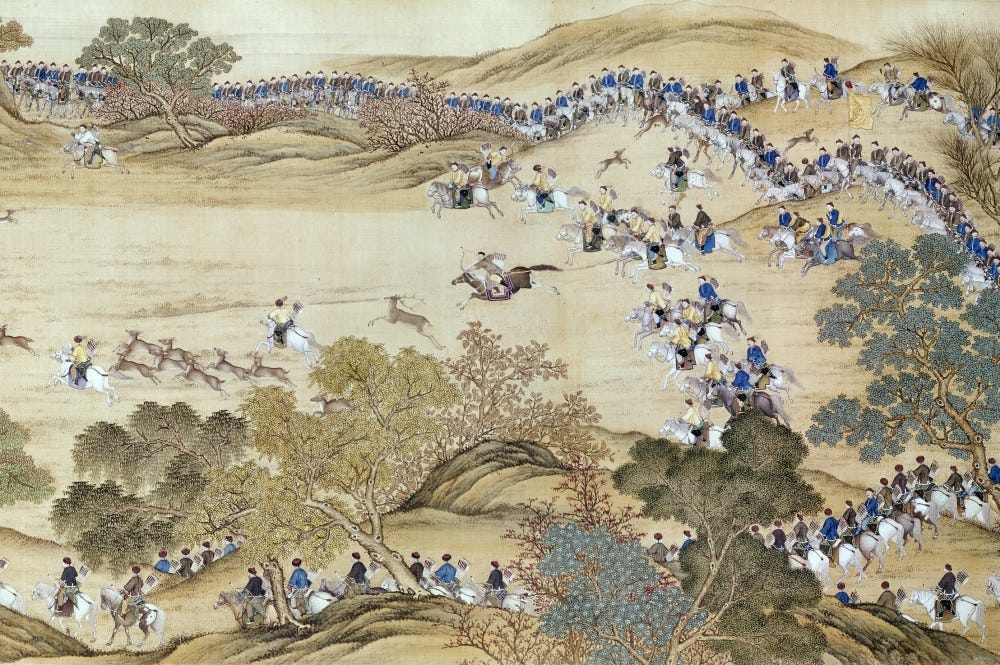
Chapter 7 describes changes to steppe societies that allowed them to conquer their settled neighbors outright—namely, the increasing practice of large-scale hunts. Horsemen would advance in a line tens of miles long, curving the ends forward to gradually envelop the game in their path. This instilled discipline and formed the basis for military tactics which allowed successful chieftains to absorb their neighbors and eventually attack civilized states, leading to the full or partial collapse of the Tang, Pratihara of northern India, Abbasids, and Byzantium in the 10th and 11th centuries.
The last two fell victim to the Seljuk Turks (although the Abbasids were already disintegrating due to internal reasons), while the Chinese faced successive waves of invaders who carved out a section of northern China (so-called warring-state period, per Tonio Andrade’s formulation, which spurred many other interesting developments in China). This began with the Khitan in the 10th century and culminated in the 13th with the Mongols—who are covered in Chapter 8. Genghis Khan was uniquely successful in uniting the various steppe tribes, and Chaffetz argues there is good reason to believe accounts that his armies reached many hundreds of thousands. Their size not just enabled his vast conquests, but required it: large numbers of horses had to remain on the move to avoid consuming all the forage, while dispersed march-routes were planned in advance during a narrow window starting in late spring. This kept Genghis’ successors rooted in the steppe as the foundation of their military power, and limited their conquests west or south—only Kubilai Khan, who completed the conquest of China, succumbed to the inherent dynamics of that country and established an essentially Sinicized dynasty.
Chapter 9 describes how the Mongols were succeeded in the 14th century by Tamerlane, who founded the last great steppe empire. Its greater complexity showed the stirrings of modernity: fixed ranks, a logistical apparatus to provide alfalfa when pasture was lacking, and a large artillery corps. His conquest of Delhi in 1398 was a mere looting expedition, but a century later his descendant Babur founded the Moghul Empire in northern India and Afghanistan. Its position gave his successors control over India’s supply of horses, allowing their cavalry to dominate nearly the entire subcontinent by the year 1700. By the same token, Persia’s expansion under Nader Shah over the next few decades cut off that supply and led to the Mughals’ precipitous decline.
Nomadic empires could not survive the rise of settled gunpowder states, however, as both Qing China and Russian Muscovy demonstrated at opposite ends of the steppe. Yet their rise was a simple story of more effective weaponry, as Chapter 10 shows, but was instead linked to their ability to break steppe societies’ monopoly on the horse supply. The Qing’s origins lay in Manchuria, which their ancestors turned into a horse-raising region to help the Ming bypass the Mongolians’ monopoly; eventually, they developed powerful cavalry of their own and conquered the Ming in the 17th century. They did not repeat their predecessors’ mistakes, keeping tight control over the horse-breeding regions of Manchuria and Mongolia, which supported their conquests up to the borders of modern China.
The Russians, by contrast, had been conquered by the Mongols in the 13th century and remained a tributary state for centuries after. Although their territory encompassed some good grasslands, they still depended on horses supplied by the Golden Horde, which dominated the steppe to their immediate east. It was only by forming alliances with the Tatars and Cossacks to the south that Russian monarchs beginning with Ivan the Terrible were able to take advantage of the fracturing of the Golden Horde.
Britain’s conquest of India in the 18th and 19th centuries also impinged on the steppe, as described in Chapter 11. The climate made it difficult to maintain heavier European-style cavalry in sufficient strength or number, pushing them to expand into Afghanistan. This brought them into confrontation with Russia, which was just then subduing Central Asia, spurring a rivalry that had global repercussions. Meanwhile, the Qing’s defeats at the hands of European navies in the 19th century led them to double down on their strengths, using their cavalry to repulse Russian incursions along their western frontier.
Chapter 12 concludes the book by looking at the twilight of horse power in the decades around 1900. Eurasia was by then partitioned among three large land powers which maintained large herds and stud farms. Yet the end was rapidly approaching with the outbreak of the First World War. A last hurrah came with the Third Anglo-Afghan War in 1919, when Afghan tribesmen descended the Khyber Pass into British India—only to be defeated by air power, that mainstay of future wars.
Discussion
Raiders, Rulers, and Traders is one of those books that makes a lot of fascinating conclusions snap into focus by applying an unusual lens to familiar topics. In this case, that lens is the economics of horse power. Although it would be a great oversimplification to reduce the book to just that, it is a thread that runs throughout (in this regard, it reminds me of nothing so much as The Gunpowder Age, another favorite which draws fascinating conclusions by looking at the parallel evolution of gunpowder weapons in China and the West from the perspective of interstate competition).
This is most straightforward in the case of China, where the monopolistic impulses of horse traders from the steppe competed with the monopsonistic impulses of Chinese emperors. It is an interesting example of what some economists call “coopetition”: a competitive framework that nevertheless requires extensive cooperation among all parties. Both steppe people and the Chinese depended on the horse trade, but understood that it also strengthened their potential adversaries. The greater struggle was therefore to control the dynamics of that trade by focusing on a number of key chokepoints along the frontier.
This is probably familiar to anyone who has studied the Han-Hun wars in depth, but is not immediately obvious to more casual readers—popular accounts tend to focus on the strictly military balance of power. And it explains much else over the longue durée: the incentive for westward expansion under the Tang, the collapse of the Song in the face of a new steppe monopoly, and the relations between the early Yuan and their cousins in the Mongolia. It also provides an interesting perspective on the rise of the Manchus, a non-steppe people the Ming used to bypass the steppe monopoly.
This framework is usefully applied across space as well, to the other great civilizations around the Eurasian steppe. The horse trade to India was always more easily controlled via a few passes in the northwest, while the land itself was far more politically fragmented—unsurprisingly, horses were much more expensive there than elsewhere. Those rare dynasties that managed to control both Afghanistan and the northern plains held an enormous military advantage: the Mughals managed to unify more of the subcontinent under their rule than any power before the British. There is an interesting parallel to be drawn with the Qing and Tang, who maintained their power against internal and external enemies by securing control over neighboring horse-rearing regions.
Russia and Persia, by contrast, were both more steppe-like and more exposed to the steppe. This simultaneously made them more vulnerable to attack and made it easier to raise large cavalry armies on their own account. There were occasional exceptions: the Golden Horde controlled such a vast extent of the western steppe that it could regulate Russia’s access to remounts, but once that monopoly was broken the Russians quickly expanded under the leadership of Muscovy.
As much as I dislike facile geopolitical analogies (“tin was the oil of the Bronze Age Mediterranean!”), it really is hard to avoid the comparison between hydrocarbons and horse power. Military strength in Eurasia was fueled by a steady supply of remounts, which made the horse trade both the object of state-level diplomacy and a frequent war aim in itself. The reciprocal influence of means and ends is reminiscent of the runup to World War II, when Britain, Germany, and Japan shaped their war plans around access to oil supply.
The focus on chokepoints also has plenty of contemporary resonance. One fascinating detail in the book was how southern India turned to maritime routes through the Persian Gulf when rivals to the north cut off their access to overland routes. Marco Polo noted how merchants at Hormuz and Kish exported thousands of animals a year to Gujarat in the 13th century. The Portuguese seized Hormuz in the 16th century to control this trade, channeling it through their colony at Goa for sale throughout the Deccan—until the Mughals threatened them with invasion for supplying their enemies.
There are many other fascinating tidbits sprinkled throughout: Chaffetz’ explanation of the Silk Road as piggybacking on the Horse Road, or the fact that the Great Wall was a consolidation of border forts built specifically to facilitate the horse trade. The long view of horse power is not entirely focused on markets, and puts many other things in perspective, such as the intensity of conquests by steppe societies around the turn of the millennium—his suggestion that this explosion was linked to the development of large-scale hunting tactics is intriguing.
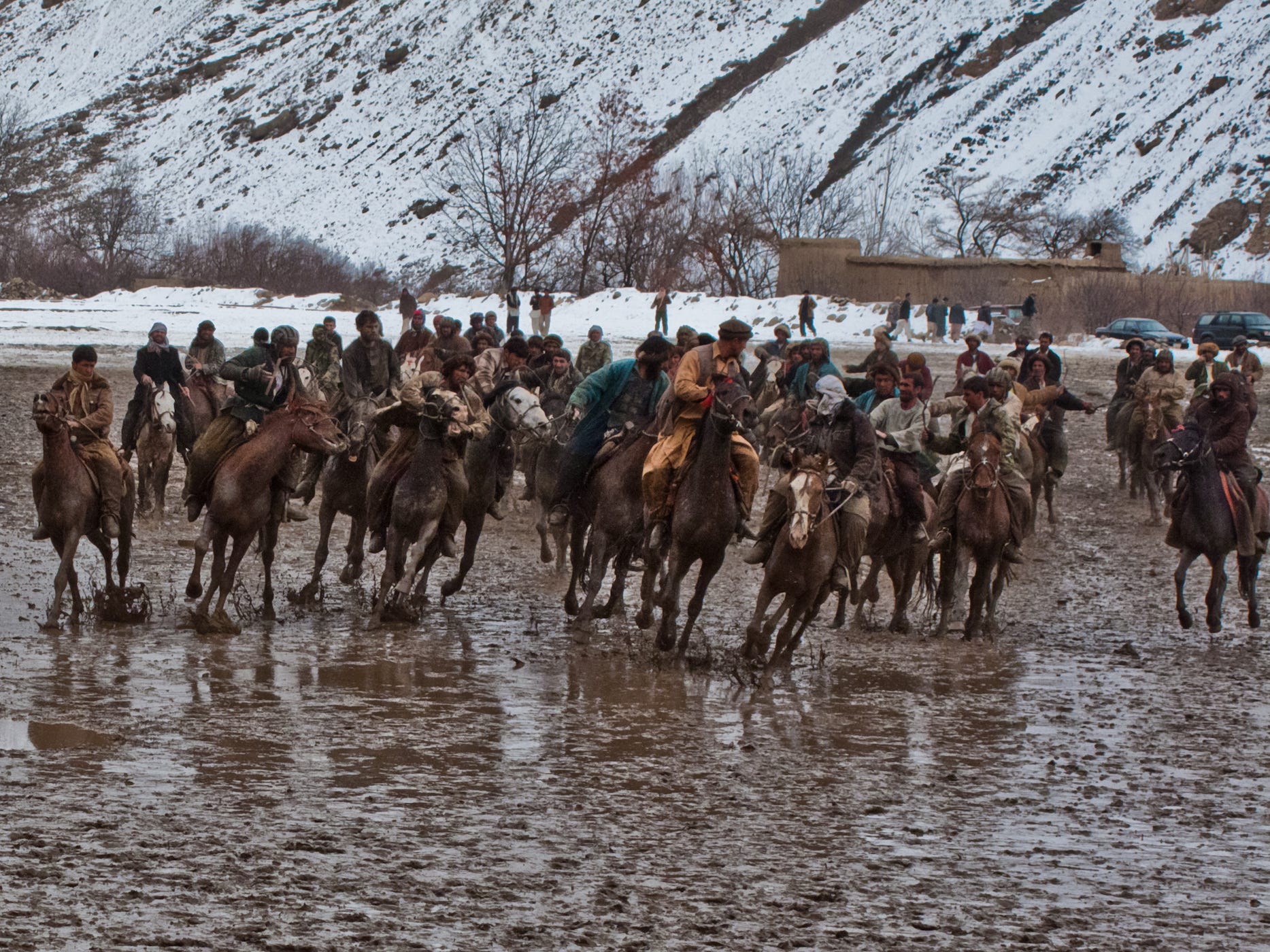
Finally, Chaffetz adds lots of color and texture to life on the steppe. He has spent a lot of time in Central Asia and surrounding lands, including a journey on horseback through Afghanistan in the 1970s, allowing him to speak directly to many of the details that do not come across in broad historical accounts. He concludes with an epilogue on buzkashi, the rough-and-tumble sport from Afghanistan in which riders compete to carry a goat or calf carcass around a distant post.
Thank you for reading the Bazaar of War. Most articles are free for all to read, but paid subscriptions are available to all who wish to support. Subscribers receive a pdf of the critical edition of the classic The Art of War in Italy: 1494-1529, and get exclusive access to monthly long-form pieces exploring selected topics in depth.
You can also support by purchasing Saladin the Strategist in paperback or Kindle format.
Fascinating read. I'm looking forward to digging into this book myself (and also looking forward to a firsthand adventure like the author's of my own one day!) Also, it's a pleasure to meet another fan of Andrade