
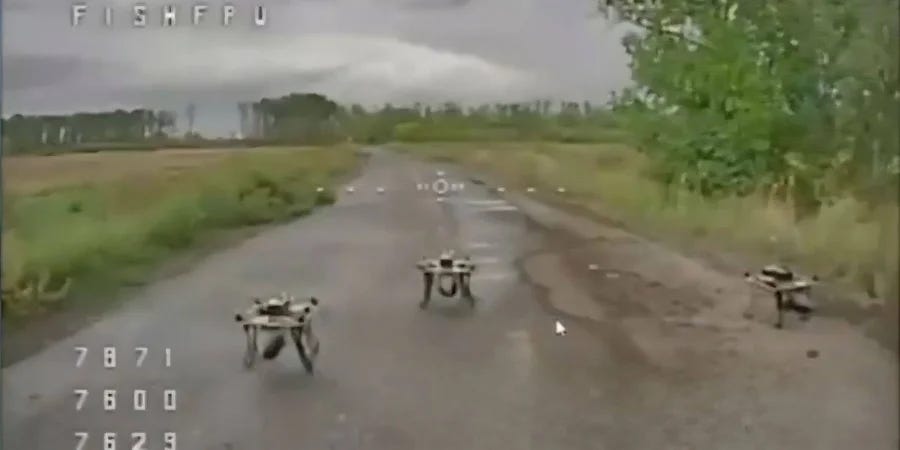
Last Dispatch ended with the suggestion that effective counter-UAS defenses would allow ground forces to concentrate once more. But how likely is that? Will counter-drone defense ever become effective enough that it becomes uneconomical to employ FPVs in mass quantities without any complementary effort? As things stand now, they are inflicting roughly 60% of casualties in Ukraine, making them a significant—although far from the only—obstacle to more decisive offensive operations.
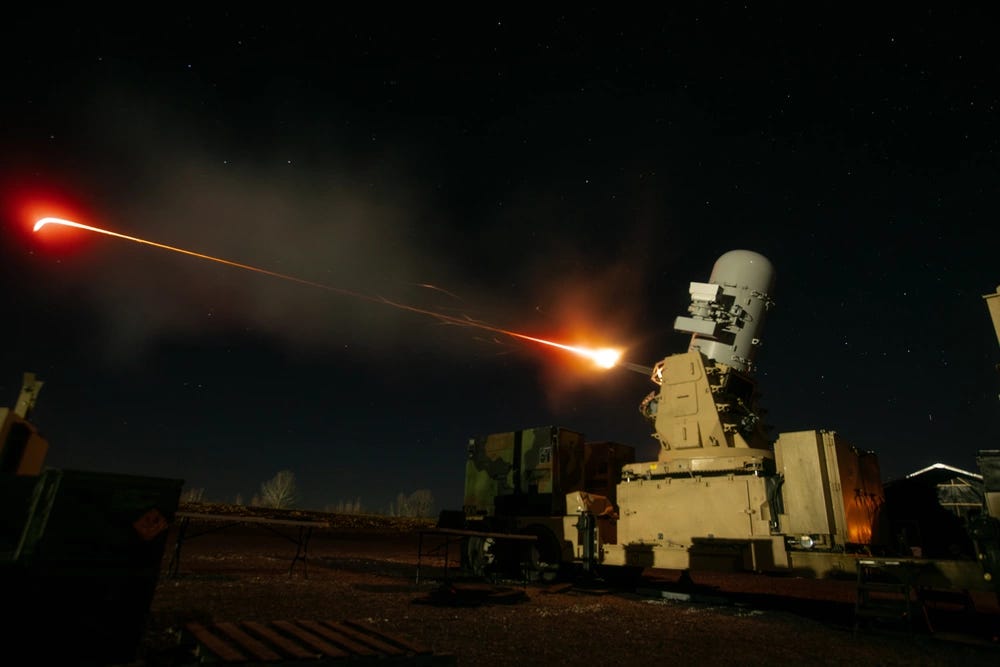
I believe the answer is undoubtedly yes. Small drones are slow-moving and fragile: from the perspective of physics, they are extremely vulnerable to any kind of kinetic fire. The biggest limitation on ground-based fires at present is accuracy. Sensors and predictive targeting are rapidly improving, however, and once they reach a certain point, AD guns will likely be an extremely effective means of defeating UAVs. With time, it is even possible that they will be effective against larger and faster Group 3 drones (such as the ones Ukraine is currently using against Russia’s operational depths).
How Would It Be Employed?
The most pressing use for C-UAS systems would be force protection throughout the rear areas. As hinted in the previous piece, this would allow and encourage a certain degree of concentration. Realistically, the effective range of these systems would run from 100s to 1000s of meters at most. This would mean defensive assets placed close enough to provide interlocking fields of fire and to achieve economies of force, but covering a wide enough area to allow dispersion against the standing missile threat—maybe 10-20 kilometers across. Defensive zones would be embedded in a broad and dense sensor net that spans the entire battlespace, providing early warning and cuing for all defensive systems (including other assets: interceptor drones, missiles, EW, etc.).
Even then, there would be plenty of seams and gaps. AD near the front line could be suppressed by enemy artillery, leaving forward troops exposed. Elsewhere, small drones could adopt “infiltration” tactics of their own, hopping from cover to cover until they find a target. And even the best defense can be overwhelmed by saturation attacks, making cover, concealment, and point defenses just as necessary as they are today. Nevertheless, effective groundfires could slow to a trickle what is today a torrent.
Offensive Concepts of Employment
Things get even more interesting when we consider the offensive role for counter-UAS fires. Employed as part of a combined-arms team, they could furnish the missing element in the current rock-paper-scissors game:
C-UAS mitigates enemy drones
Offensive drones target enemy artillery
Artillery suppresses enemy C-UAS
Infantry/armor secures ground for forward displacements
Unlike the plethora of unanswerable fires that have defined the Ukraine War thus far, the emergence of drones along with effective drone countermeasures would drastically alter the equation. No longer would an unbalanced combined-arms team favor the defense, but would provide sufficient protection to make offensive action viable.
The key is, of course, concentration. When weapon systems give no obvious advantage to the attacker or defender, success comes down to whichever side can out-concentrate the other—a question of operational art, not of tactics.
The Enduring Challenge of the Offense
There still remain plenty of obstacles to operational mobility, and in any ambitious offensive C-UAS systems would be just one small part of a very complex scheme of maneuver. Any large concentration of forces would be an inviting target for harder-to-defeat missiles and large drones, requiring plenty of higher-end air defenses, and getting under cover quickly will remain an enduring priority for ground forces between movements.
Minefields would remain just as big an obstacle as they were in 2023, requiring substantial engineering assets to pass through quickly. Analogously, smaller UAVs could remain a threat by being employed in a similar way: lying in wait along the path of an advancing force to attack from close range, where defenses are far less effective (similar to the pop-up ambushes that occur now).
And that is not to underplay the difficulty of developing effective C-UAS weapons in the first place. Although basic physics demonstrates their feasibility in principle, developing accurate targeting and networked sensors is hardly a trivial task; deconflicting with friendly UAVs in an operational environment only adds more complexity.
Nevertheless, that mere feasibility offers a glimpse of new possibilities. We have seen plenty of times in the past few years how small technological changes can dramatically change tactics, while tactics in turn shape operations. So simple a development as counter-drone guns has the potential to radically alter the battlefield yet again.
Thank you for reading the Bazaar of War. Most articles are free for all to read, but a subscription option is available to all who wish to support. Subscribers receive a pdf of the critical edition of the classic The Art of War in Italy: 1494-1529, and will have exclusive access to occasional pieces.
You can also support by purchasing Saladin the Strategist in paperback or Kindle format.
With increased autonomy, and a few more loops around the measure-countermeasure cycle, I also expect we will see the development of UAS that serve an area air defense role. As the units themselves need better performance (physical or cognitive) to defeat tougher defenses, there will also be more of an incentive to disentangle the role of 'platform' from that of 'munition.'
In the near future, most armored vehicles should be armed with short range are defense. It does not take much adaption to turn a current systems like CROWS into an air defense role. The newest Infantry Carrier Vehicle variants of the Dragoon Stryker have the ability to shoot a wall of flak at drones. Widely adopted radars and other means of target acquisition between vehicles will mean small-UAS has an incredibly short life span on the battlefield (even less of a life span than drones currently have in Ukraine). They will continue to play a critical role as expendable reconnaissance assets for decision-making and artillery targeting, but the FPV suicide drone will play a diminishing role.