
To truly understand any complex topic requires studying it from a variety of angles. One perspective can reveal blind spots not visible from another, while itself benefiting from the context those complementary views provide. Not all points of view are equal, of course, and sometimes two perspectives can complement each other especially well, adding depth far beyond the sum of their parts.
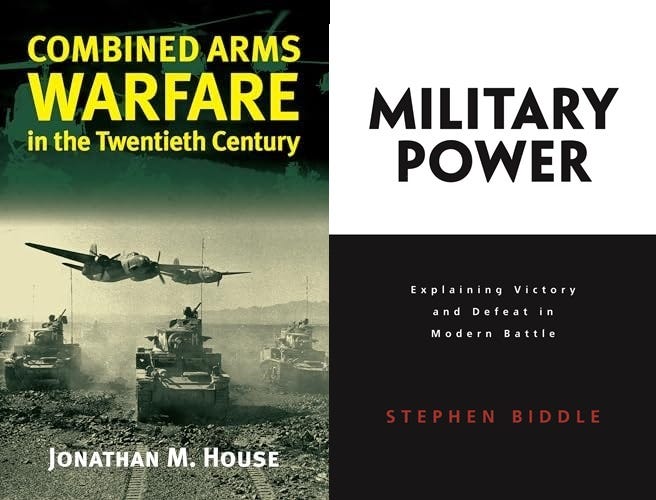
In the case of combined-arms warfare and force design, Jonathan House’s Combined Arms Warfare in the Twentieth Century and Stephen Biddle’s Military Power form one such pair. Neither is very long, about 200 pages each, but together provide a much deeper understanding of their subject, tactics and operations in the 20th century.
What makes this period distinct is that firepower decisively overtook manpower in importance. No longer was a brisk charge sufficient to rout an enemy line. Fires were too accurate, too deadly: any unsupported attack across open ground was bound to result in slaughter. Combined arms assumed greater importance than ever before, making their effective employment the central question of tactics. The two books take radically different approaches to the question of how military establishments reacted to these demands.
Combined Arms Warfare in the Twentieth Century
The first of these began as the author’s 1984 thesis while a captain at the Command and Staff College at Fort Leavenworth, published under the title Toward Combined Arms Warfare: A Survey of 20th-Century Tactics, Doctrine, and Organization. Two decades later, he expanded and updated it for a more general audience under the title Combined Arms Warfare in the Twentieth Century to include the conflicts of the 1990s.
The chief concern of this book is force structure: how armies adopted new weapons into existing formations to meet the tactical challenges of the moment. To this end, it focuses on two questions in particular: the specific balance of arms (the overall proportion of infantry, tanks, artillery, etc.), and how they are integrated—i.e. at which echelons they are brought together in a single unit. Combined arms are obviously more effective the more closely coordinated they are, but low-level integration poses command-and-control challenges.
As a simple example, most armies entered World War I with just 24 machine guns per infantry division, and by the end had around 100. But mere mass was insufficient: employing them effectively required new tactics, and hence new organization. Instead of holding all automatic weapons at the battalion or regimental level, light machine guns formed the base of fire for sections and squads; this in turn required rigorous training of the infantry in small-unit fire-and-movement tactics.
As more specialized weapons were introduced in World War II, this became a more difficult question. In the case of anti-tank guns, was it better to integrate them at the subunit level,or to keep them as part of a general reserve at a higher level, apportioning them out as necessary? The best solution proved highly variable, and commanders could not be wedded to one ideal template.
It is not always so easy to exercise combined arms at lower levels, even when the appeal is evident. As late as 1942, the British faced serious difficulties integrating infantry, armor, and artillery below the corps level. For this reason, the author defends Montgomery’s caution in the Western Desert Campaign: although contemporaries criticized him for not aggressively exploiting his victories, doing so in an ill-coordinated manner risked catastrophe. Nor was it easy to strike the right balance of new weapons. As much as armies in 1914 suffered from a shortage of machine guns and artillery, more was not always better: tank-heavy armored divisions of the interwar years proved cumbersome, lacking the infantry or artillery support that proved necessary in the trial of combat.
The book’s aperture widens in the post-WWII era. In addition to NATO and Warsaw Pact preparations for a future war in Europe, House looks in greater detail at conflicts farther abroad. A running dilemma among all powers was balancing requirements for a major conventional war against the more immediate priorities of small wars, such as Britain and France faced in their colonies, the US in Vietnam, and the Soviets eventually faced in Afghanistan. The competing priorities demanded radically different employment of armor, air power, etc.
This problem was especially acute for the US, which came to rely heavily on helicopters in Vietnam. Not only were they a more effective CAS platform than fixed-wing alternatives, but they gave ground troops much greater mobility in the dense jungles. It remained an open question whether fragile helicopters would be useful in high-intensity conflict: although both sides of the Cold War developed new concepts in the late 1970s and 80s for tank-killing air cavalry paired with air-mechanized assaults, these were never put to the test.
By looking at a greater variety of theaters, the second half of the book also illustrates the influence of geography on force design: not only with American helicopters in Vietnam, but also with Chinese and North Korean armored divisions. Following the Korean War, the Asian communist powers retained the basic organization of their Soviet counterparts, but with higher concentrations of high-elevation mortars and anti-tank weapons needed for mountainous terrain.
Fittingly, House concludes with Russia’s Chechen wars of the 1990s. Publishing just months before 9/11, he had no idea that America would soon embark on a two-decade counterinsurgency in the Middle East. Yet, as he reminds us, however much care goes into organizing the military, it is impossible to tell just what demands will be placed on it—one of the enduring challenges of force design.
Military Power
The second book, Stephen Biddle’s Military Power, takes a very different approach. Rather than look at the particulars of tactical problems at various times, it examines the very basis for military success across the entire 20th century. Using statistical analysis on a wide sample of battles and operations, Biddle argues against traditional explanations such as preponderance of force, technological advantages, or periodic shifts in relative strength of the offense and defense. Rather, he argues it comes down to effective employment of what he calls the modern system: a set of principles refined in the last year or so of the First World War in response to the increasing lethality of modern weapons.
The modern system, as Biddle defines it, entails the judicious use of cover, concealment, dispersion, small-unit maneuver, suppression, and combined-arms integration. At the operational level, a defender must also arrange his forces in depth to disrupt an attack while maintaining adequate reserves to counterattack (it could also be argued from Biddle’s own evidence that attacks must likewise be echeloned, although he himself does not make that point). Taken together, the modern system makes it easier for an attacker to take ground at the expense of a dispersed defender; but by the same token, the attacker’s slower, more deliberate pace makes it harder to create exploitable breakthroughs.
For those who have studied the breadth of 20th-century military history in some detail, this may seem self-evident. What is impressive about Military Power is how Biddle marshals statistical evidence to show just how much this is the case: when force employment is accounted for, even vast technological and numerical gulfs matter far less than one would expect (one must also consider Biddle’s audience—chiefly IR and strategy academics—and the shift in consensus understanding over the past twenty years).
The first two chapters demonstrate how traditional measures of military power (GNP, population, military personnel, etc.) are hardly better than a coin-flip in predicting the outcome of a war. The next two chapters elaborate the mechanics of the modern system as it first emerged in 1917-18, showing why it has been so enduring even in the face of new technologies that would presumably negate its effectiveness.
A formal mathematical model is articulated in the appendix. It describes a straightforward scenario of an attack along part of a continuous front, modelled in terms of several parameters: balance of forces, width of the attack, width of the entire front, depth of the defense, speed of advance, size of the reserve, modernity of each side’s weaponry, etc. Such a model cannot account very well for force employment at the tactical level, and real-world data is far too noisy to estimate specific outcomes; but by playing with different variables, Biddle makes a plausible case that certain operational parameters (defensive depth, size of reserves, speed of advance, width of attack front, etc.) far outweigh straightforward correlation-of-forces measurements.
Chapters 5-7 use this model to analyze three case studies spanning the 20th century: Operation Michael (the first of Germany’s 1918 spring offensives), Operation Goodwood (the penultimate Allied breakout attempt in Normandy in 1944), and the ground invasion of Operation Desert Storm in 1991. Biddle shows how his model accurately predicts the outcome of the first two (a successful breakthrough in 1918 and offensive failure in 1944), contra the implications of more traditional correlation-of-force measures, and provides a very different explanation for the overdetermined coalition victory in Desert Storm. Just as important are his qualitative descriptions of these operations—already familiar to readers of House—which give an intuitive understanding of why these resulted in the way they did. The conclusions from these limited samples are then supported by Chapter 8, in which competing models are applied to several large datasets covering battles and wars across the 20th century.
Most compelling of all is Chapter 9, which describes the results of a combat simulation run on the Battle of 73 Easting. This was a tank battle during Desert Storm in which a squadron-sized US Army formation destroyed two Iraqi armored brigades at the loss of a single vehicle. It was also the best-studied battle of the modern era, as research teams conducted a thorough investigation immediately afterward. This allowed other researchers to run the scenario through Janus, a battle simulator that accounts for weapon systems, terrain, and many other inputs.
Traditional explanations for the lopsided outcome at 73 Easting emphasize American technological superiority: thermal sights on the M1A1 Abrams, longer gun range, air superiority, etc. However, the Iraqis also committed two key tactical errors: their fighting positions on the forward slope of sand dunes provided little cover while making them more conspicuous, and their forward elements did a poor job of alerting the main body of the American advance.
The results from Janus paint a very different picture from the traditional view. Several counterfactuals were tested: in which the Iraqis corrected one or both of their major errors, in which American tanks lacked IR sights, and in which the US lacked airpower. The outcomes strongly supported Biddle’s hypothesis: effective implementation of modern tactics by the Iraqis had by far the biggest impact, resulting in higher overall losses for the Americans. Testing the impact of IR sights also yielded interesting results: it produced a lopsided American victory when the Iraqis made one or more tactical mistakes, but had little impact when they didn’t. Biddle’s explanation is convincing: “Where superior technology comes into its own is in punishing the mistakes of a non-modern-system opponent.”
The Two Lenses
House and Biddle complement each other very well. The specific tactical schemes detailed in Combined Arms Warfare in the Twentieth Century give flesh to the abstract dynamics of Military Power, while those abstractions help avoid missing the forest for the trees amidst masses of organizational details. Although it is probably easier to read House before Biddle, both are readily understood on their own merits.
What separates the two is that Combined Arms is also more of a straightforward description, less subject to debates over interpretation. Statistical analysis of messy datasets is bound to be imperfect, and there are a few points where the details given in Combined Arms suggest varying interpretations to the arguments laid out in Military Power. One such point—and one of Biddle’s few conclusions I disagree with—is the claim that new technology does not provide any inherent benefit to the attacker or defender. Although he convincingly shows that national identity of the attacker was by far a better predictor of offensive success than period in which the attack was conducted (Germany was consistently the most effective throughout the first half of the 20th century), two points must be noted.
The first is that Biddle’s analysis only accounts for tactical success. The Germans broke through British lines in Operation Michael, but were unable to exploit it operationally for lack of technical means (i.e. wheeled transport). Secondly, while it may be true that there is no long-term variation in the tactical balance between the offense and defense, improved firepower almost automatically aids the defender, whereas the attacker must develop new methods of cover, concealment, and suppression to negate it. It is noteworthy that the Germans took three full years to develop effective assault tactics in WWI, yet entered WWII with a well-developed concept that proved successful from the outset.
Into the 21st Century
Which brings us to the present moment. The fighting in Ukraine certainly resembles WWI insofar as it has proven remarkably difficult to develop effective tactics, and meaningful operational success has so far eluded both sides. Although it is certainly possible that we are entering a wholly new paradigm in which even the modern system cannot deliver victory on the battlefield, in which economic and infrastructure attacks decide wars, it seems at least as likely that we are in a painful transition period on the order of 1914-17.
It has been well over 20 years since Combined Arms and Military Power were published—in 2001 and 2004, respectively—yet they both shed much light on present circumstances. Force design, to include both the balance of new weapons in existing formations and also the level at which drones must be integrated, remains an enduring challenge. So too has implementing the modern system: casualties seem directly proportional to the care with which cover and movement are measured at the smallest level, and even where both sides have developed effective techniques, their organizations do not always implement them.
From this perspective, drones do not mark a radical departure from the modern system. Instead, they represent a substantial increase in information flow and a step change in lethality of firepower. The looming questions are therefore:
1) How to apply the modern system in a drone-heavy environment? It is obvious that any solution must somehow suppress drones and provide for cover/concealment, but implementing that remains a challenge.
2) Once militaries do develop effective offensive techniques, how should they structure their command relationships and force balances? This is doubtlessly a moving target that offers no stable solution, only adding to the difficulties.
Although the patterns may be clear, the answers are never easy.
Thank you for reading the Bazaar of War. Most articles are free for all to read, but a subscription option is available to all who wish to support. Subscribers receive a pdf of the critical edition of the classic The Art of War in Italy: 1494-1529, and will have exclusive access to occasional pieces.
You can also support by purchasing Saladin the Strategist in paperback or Kindle format.