
The purely military aspects of strategy often get short shrift. They lack the complexity—or at least dynamism—of tactics and operational art, and are often eclipsed by more political questions of mobilization, industrial policy, fiscal measures, managing alliances, and so forth. Military strategy as such is often relegated to prioritizing theaters and defining achievable objectives for them.
Much of this has to do with the fact that most wars are ultimately won by attrition. Efficiently trading losses with the enemy requires careful decision-making, to be sure, but these are not urgent—they involve developing and refining priorities over time. Even the question of opening a secondary theater is usually a matter of whether it will bring about favorable loss-ratios.
Avoiding costly attritional victories means leveraging the critical element of time: instead of trading losses until the enemy is exhausted, a combatant exploits brief windows of opportunity to secure much larger gains. Contra the commonplace dichotomy, the opposite of attrition encompasses much more than mere “maneuver”—most non-attritional strategic victories are won by rapidly exploiting a decisive operational victory in a single theater (e.g. most of Napoleon’s campaigns, or the 1940 invasion of France). But this does raise an interesting question: why do we so rarely see anything that could be called maneuver at the strategic level—actions across multiple theaters that create synergistic effects?
The explanation lies partly in the sheer scale of warfare at the highest levels. The complexity and time involved in a major offensive makes it difficult to tightly orchestrate effects, and even more difficult to quickly pivot to exploit fleeting chances. Moreover, strategic posture is inherently less sensitive to rapidly-changing circumstances—a breakthrough in one theater will not necessarily imperil others in the way a tactical or operational breakthrough would. Nevertheless, a closer examination of history reveals some examples of more sophisticated military strategy.
Simultaneity
The closest that most conflicts get to exploiting time is by launching simultaneous offensives on multiple fronts: either to prevent reinforcements from being moved from one to another, or simply in the hope of causing one to crack. But it is one thing to plan a series of simultaneous offensives, quite another to synchronize them.
As we saw in the last Dispatch, the Tullahoma Campaign demonstrates this well. This operation in Tennessee was one of three major Union offensives scheduled for spring 1863, along with campaigns in Virginia and Mississippi. But the difficult terrain and logistical factors of region meant that it could not be launched until a full two months after the others, and it failed to prevent Confederate reinforcements from being sent from Tennessee to Mississippi. In the event, Union victories in both theaters owed more to numerical superiority than to any strategic synergy (although their efforts in Tennessee certainly benefitted from the unintended transfer of Confederate reinforcements).
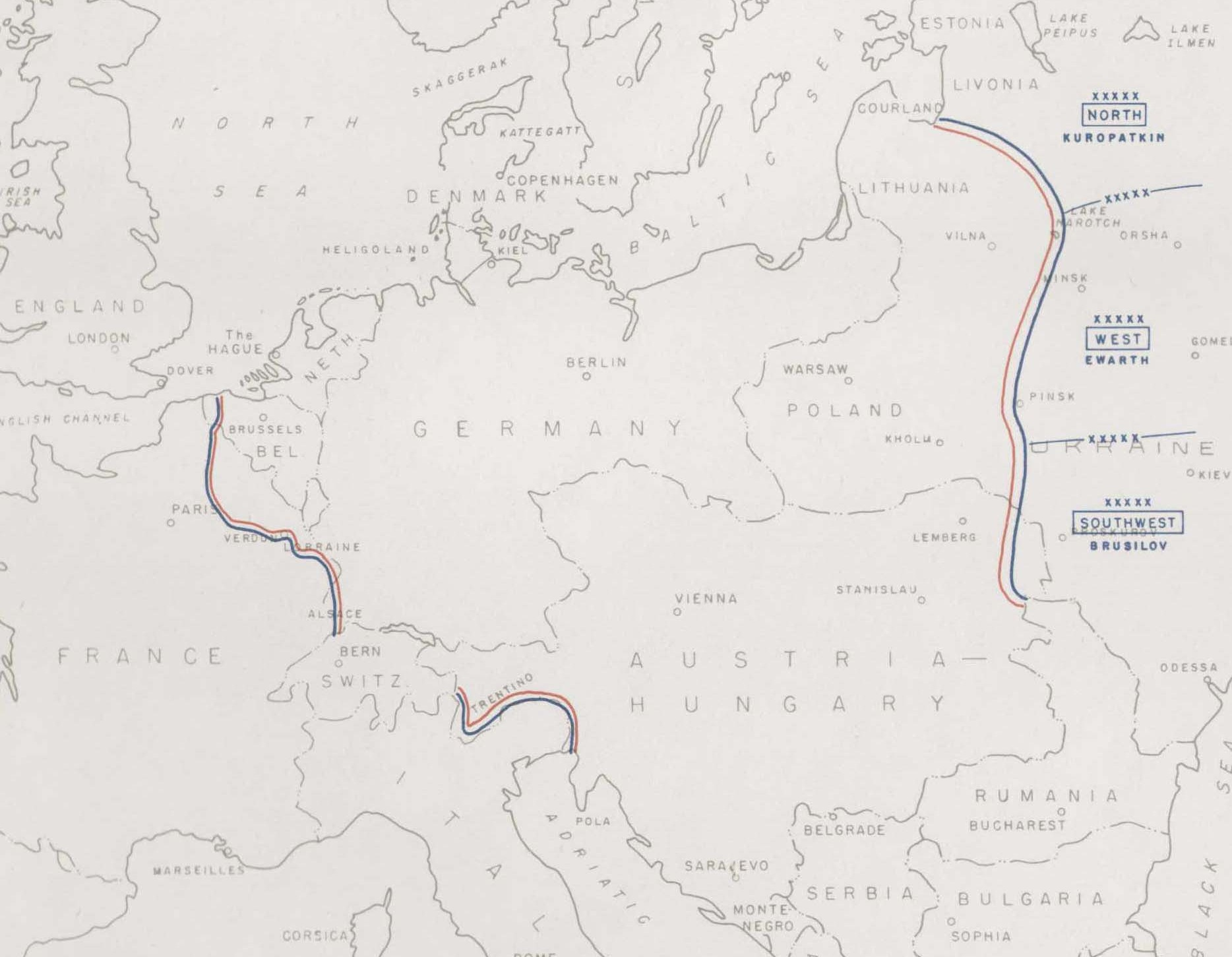
A similar situation occurred in World War I, when the Allies planned simultaneous offensives for summer 1916 in Ukraine, France, and Italy. These achieved more tangible effects, but only imperfectly, as they were launched sequentially over two months. This partly worked to their advantage, as the Central Powers sent reinforcements east before the other two offensives began, although no single front collapsed—it is conceivable that more decisive results could have been obtained in Ukraine had all been launched simultaneously.1
Converging Fronts
One step beyond simultaneous offensives is when multiple offensives take place in adjacent theaters that converge on the same objective. This offers the chance of true maneuver, forcing the defender to carefully calibrate his strength in each direction: if he miscalculates and the attacker breaks through one front, he risks losing the objective and suffering an envelopment on the other.
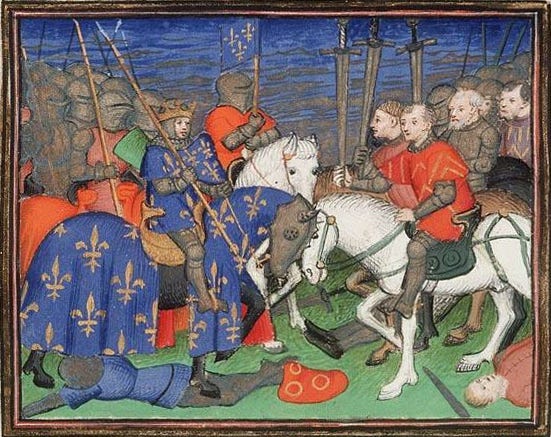
Yet the attacker’s task is at least as hard: this gives the defender the benefit of interior lines, making timing even more important, lest the defender defeat his separate thrusts in detail. An early example of these difficulties came in 1214, when King John of England allied with the Holy Roman Empire to invade France from two directions: John from the southwest, in order to draw the French out against him, while affording Emperor Otto an unimpeded advance on Paris from the north. The latter tarried in getting underway, however, allowing the French king to drive back the English before concentrating his army against the Germans, winning an important victory at Bouvines that summer.
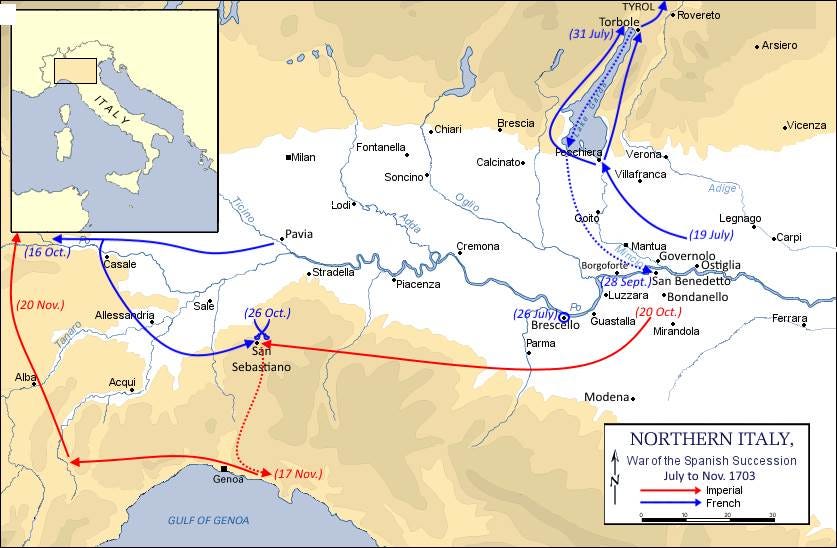
A similar case is found in French plans for the 1703 campaign of the War of the Spanish Succession. A Franco-Bavarian army in southern Germany was to drive south into the Alps while a Franco-Savoyard army in Italy hooked north, knocking the Austrians out of their central position and opening the road to Vienna. The Bavarians were too anxious over their own territories to press the attack, however, while the French learned that their Savoyard allies were planning to defect, forcing them to withdraw from a vulnerable position in the Alpine valleys.
The examples of 1214 and 1703 illustrate how sustained pressure on both fronts is necessary for success. A skilled defender can therefore disrupt this with strategic maneuvers of his own, using holding forces paired with rapid troop transfers to exploit any disjointedness in enemy actions. Frederick the Great demonstrated this throughout the Seven Years’ War, moving between Bohemia to the south, Silesia to the east, Saxony to the west, and Prussia to the north. In an especially busy 16-month period from 1757 to 1758, he withdrew from Bohemia, where he had suffered reverses at the hands of the Austrians, dashed west to Saxony to defeat a combined Franco-Imperial army, then east to Silesia to defeat the Austrians, north to halt a Russian offensive, then back south to face the Austrians once more.
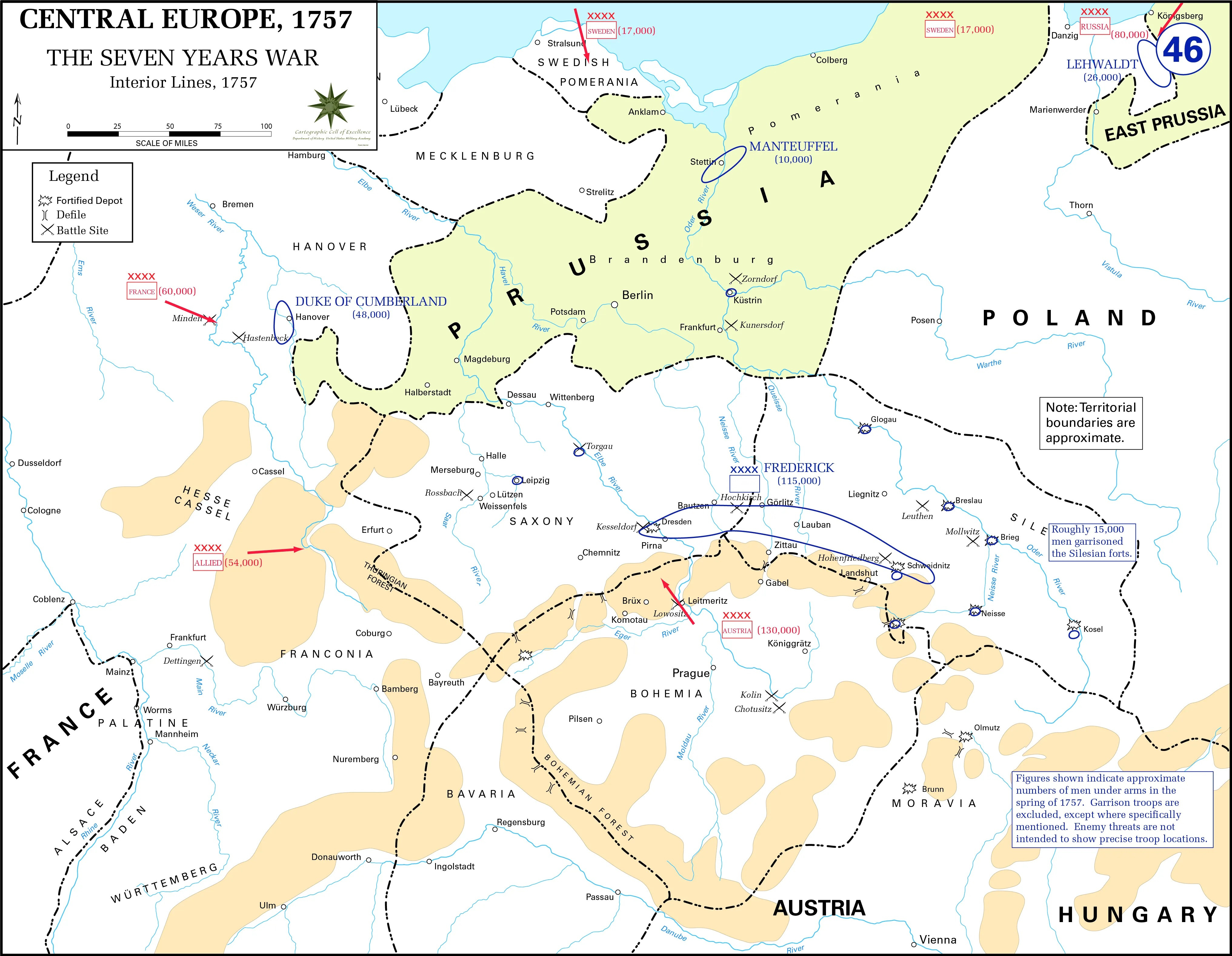
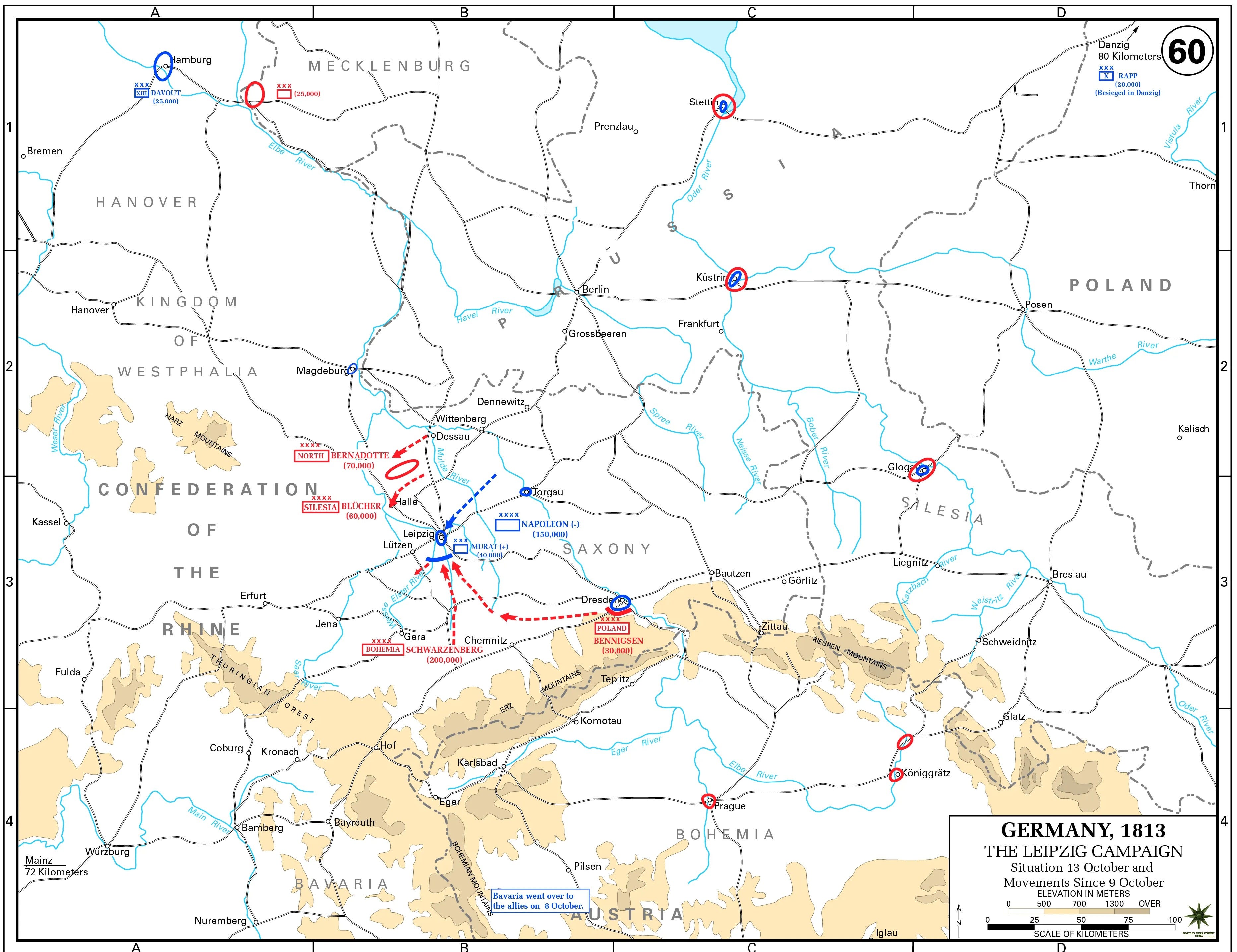
A more successful example of offensive coordination can be found on that exact territory in 1813, when three Allied armies converged on Napoleon’s position in Saxony: one from Prussia in the north, another from Silesia in the east, a third from Bohemia in the south.
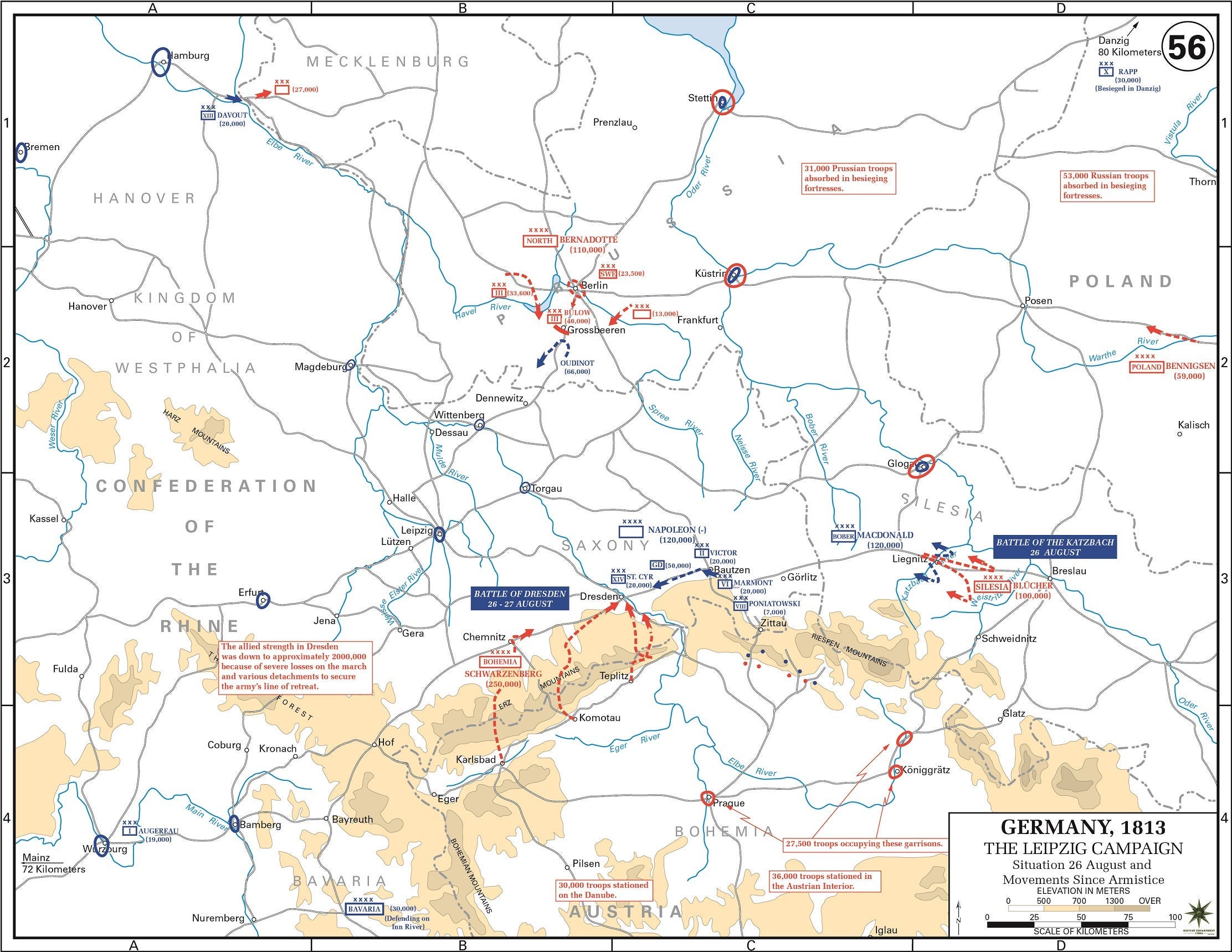
The French emperor attempted to defeat these separate thrusts in detail as Frederick had, but the Allies solved the coordination problem with a simple algorithm: each army would maintain the offensive except when Napoleon was personally present, in which case they would avoid battle (so great was their respect for his generalship); only when all three armies joined up would they fight a decisive action. By these means they succeeded in enveloping his army around Leipzig in October, where on the 16th they fought a massive 4-day battle that decisively crushed him.
The Technological Factor
It is noteworthy that these maneuvers could only take place when the theaters themselves were small. Although the scales involved were well beyond operational depth—each of Frederick’s marches in 1757-58 was over 100 km, as were Napoleon’s thrusts from his base at Leipzig—they could be accomplished by entirely foot-mobile armies in a matter of days or weeks. Just as crucially, this allowed the attacker to coordinate their actions more easily.
It is therefore evident that technology is a vital component of larger-scale strategic maneuvers, both to move assets across greater distances and to manage the exponential growth in complexity. That was certainly the case in the vast theaters of the Pacific War, where we see a variation on the pattern of converging fronts. Allied forces under General Douglas MacArthur moved through the Southwest Pacific in parallel to Admiral Chester Nimitz’ drive through the Central Pacific, with the ultimate aim of Japan. These were not quite converging offensives—it would take several years before they could reach the Japanese home islands—but they drew resources from each other.
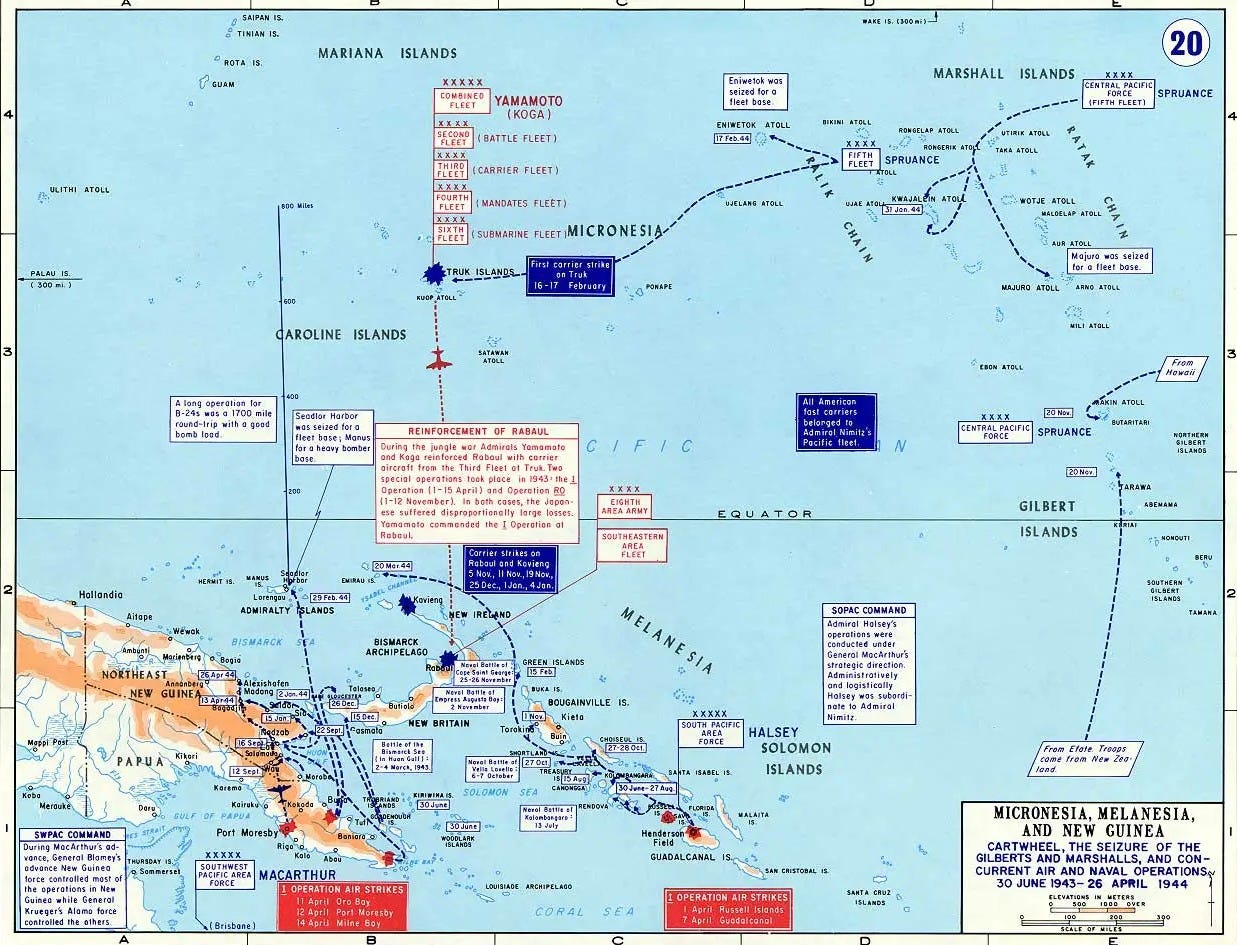
In this case, the Allies were often helped by the desynchronization of efforts. Alternating thrusts kept the Japanese off balance, as they repeatedly prepared to defend along one axis, when the major blow came on the other. This deception was not wholly deliberate—the mounting of such expansive operations took great time and preparation—but the Allies exploited it all the same.
True Maneuver
Converging offensives are a genuine, if elementary, type of strategic maneuver. If we were to analogize these to the operational level, it would be like a double envelopment: just as an operational envelopment offer the chance of an overwhelming local tactical advantage, strategic maneuver offers operational advantages.
Extending this analogy between levels, we can also look for the sorts of deliberate feints and shifts of attack that is so common in operational art. We find one such instance in 1704, the year after the French attempted their envelopment on a grand scale, the Allies undertook a more successful maneuver of their own. Leaving the bulk of his army to defend the all-important Low Countries theater (modern Belgium), the Duke of Marlborough marched with 21,000 men to Bavaria to reinforce his Eugene of Savoy against a renewed Franco-Bavarian offensive toward Austria.
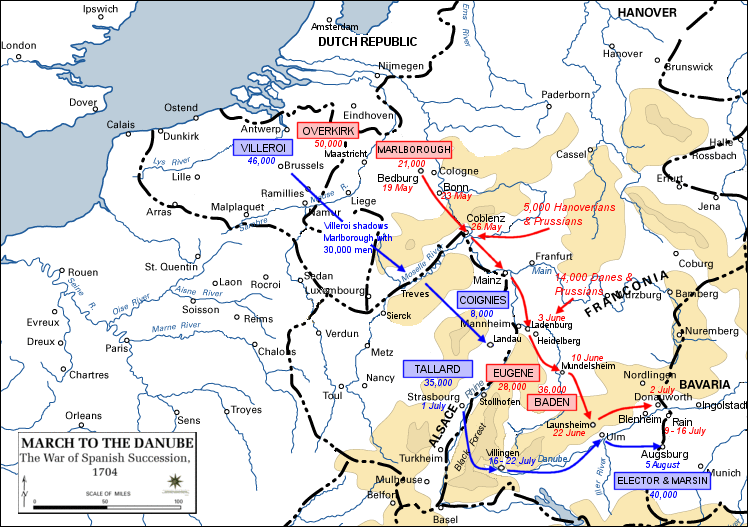
The first phase of this movement was a straightforward movement from one theater to another, which Marlborough’s opposite quickly detected and set off in pursuit. After crossing the Rhine, however, Marlborough entered the territory of true maneuver. He constructed bridges further south as if to recross the river into Alsace, forcing the French to hesitate. Eugene then marched west to the Rhine with 28,000 troops to block French forces in Alsace from intercepting Marlborough, who continued his march southeast toward Bavaria. Although the French army in Alsace did ultimately manage to reinforce their compatriots on the Danube, their slow movement through the Black Forest allowed Marlborough to get there first. Although still slightly outnumbered, he and Eugene, two of the finest generals of the age, won a tremendous victory at Blenheim.
The campaign entailed a fairly simple strategic maneuver, little more than a feint followed by a rapid movement—Marlborough’s army created the very window of opportunity through which it leapt, with only secondary support from Eugene. This was not comparable to the sophisticated operational maneuvers by widely-separated corps that contemporary armies were already capable of.
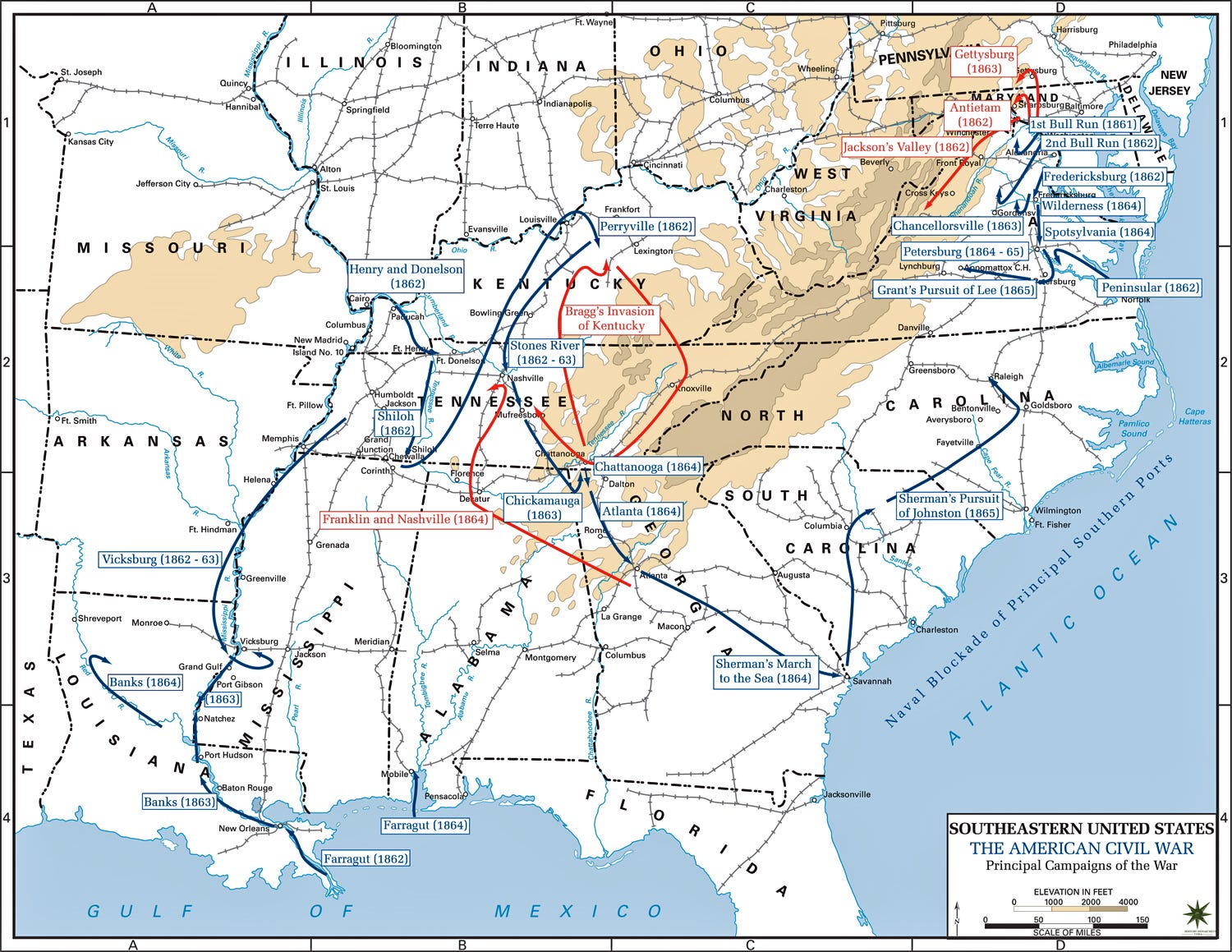
A more interesting case can be found in the wake of the Union victories of summer 1863, when the main effort of both sides shifted to Tennessee. As Rosecrans prepared to exploit his victory at Tullahoma with a drive toward Chattanooga, the important rail hub, he grew concerned that the Confederate army there would receive reinforcements: this would leave him extremely vulnerable to a counterthrust as he crossed the difficult barrier of the Cumberland Mountains.
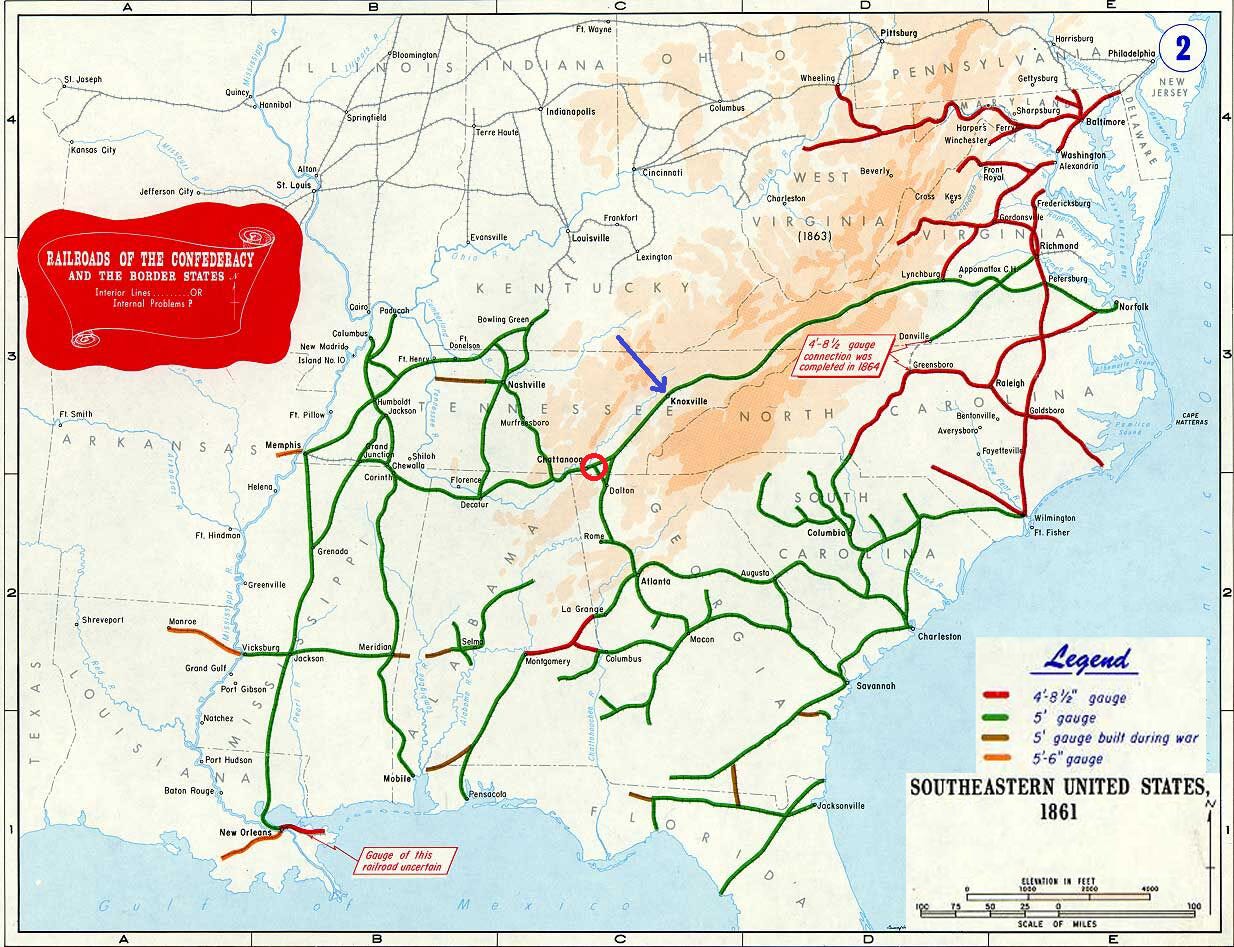
The most likely source of reinforcements was Virginia, where Robert E. Lee had largely contained the Union advance following his defeat at Gettysburg that July. Virginia enjoyed direct rail communications with Chattanooga, allowing reinforcements to be sent in a matter of days. The War Department therefore adopted a multiprong strategy for late August/September: as Rosecrans advanced on Chattanooga, the smaller Army of the Ohio under Ambrose Burnside would take Knoxville on the Chattanooga-Virginia line, cutting off the most direct route for reinforcements. This would have the additional benefit of opening another avenue of advance on Chattanooga down the Tennessee River valley, opening the possibility of an operational envelopment.
As with all maneuver, however, the window of opportunity was brief. Reinforcements could still arrive via a longer route, giving Rosecrans just a few weeks from the start of his operation until his opponent would outnumber him. Next piece for paid subscribers will look at how the complex maneuvers of the Chickamauga Campaign played out.
Thank you for reading the Bazaar of War. Most articles are free for all to read, but a subscription option is available to all who wish to support. Subscribers receive a pdf of the critical edition of the classic The Art of War in Italy: 1494-1529, and will have exclusive access to occasional pieces.
You can also support by purchasing Saladin the Strategist in paperback or Kindle format.
In truth, the failure to win greater success owes far more to the hesitancy by Russia’s own Western and Northern Fronts (army groups) to launch their own offensives (the Brusilov Offensive in Ukraine was conducted by the Southwestern Front).
Thanks ! Insightful as usual. What about the combination of Overlord and Bagration which was agreed during the Tehran conference (as far as I recall..) ? German forces could never recover from the summer 44 defeats which led to the destruction of Army Group B in Normandy and to the annihilation of Army Group Center in Central Europe.
And your last paragraph emphasizes Grant's strategy upon arriving in the East, press Lee hard in defense of Richmond to make sure he would not be able to send significant reinforcements to any of the other theatres.