
The last piece on Arab-Byzantine warfare looked at strategy along the Anatolian frontier in the first century of the Islamic conquests. We saw how the Arabs followed a two-track policy: to conduct frequent but limited raids, similar to the logic that defined Native American warfare, paired with occasional deep incursions which had as their ultimate aim the capture of Constantinople itself.
The great siege of 717-18 represented a high-water mark of early Islamic expansion, the closest any Muslim army came to taking Constantinople until the Ottoman Turks seven centuries later. Despite its failure, the Umayyad Caliphate kept up the pressure over the next three decades with a series of aggressive near-annual raids. This long offensive masked deeper problems among the Umayyads, however, who in 750 were swept aside by a new dynasty: the Abbasids.
The Caliphate reached its apogee under Abbasid rule from Baghdad. Although their territory was not as extensive—Spain and North Africa fell away—they were richer and militarily stronger, and continued to push their borders eastward into Central Asia. Along the Byzantine frontier, the Abbasids continued their predecessors’ strategy of regular cross-border raids paired with occasional deep incursions into Anatolia.
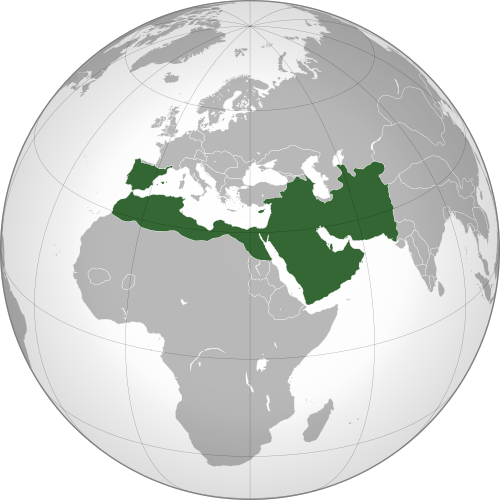
But Byzantium was also growing stronger, having recovered somewhat from the shocks of the previous century. Its economy adjusted to the loss of Syria, Egypt, and North Africa, and the Anatolian frontier grew more resilient against hostile incursions, while the state bureaucracy got better at employing the empire’s diminished resources. Finally, the army learned to fight this new enemy, developing techniques to blunt the effectiveness of their incursions.
This changed the balance of power in the Abbasid period. While the Islamic Caliphate remained measurably stronger than their Christian opponents, their relative advantage diminished. And if Byzantine adaptations did not by themselves improve the empire’s material conditions, they lay the groundwork for an economic turnaround following the Umayyad collapse, when the population grew, settlement patterns expanded, and trade and agricultural output both increased.
Part 1 of this series looked at the first century of the Arab-Byzantine wars from the perspective of strategy. It gave particular emphasis to the Arab side of things—whereas Byzantine strategy was focused above all on survival and damage mitigation, Arab objectives varied considerably according to immediate circumstances and the wider political situation.
This installment, which covers the second century of the conflict, also examines Arab strategy, considering how it changed in an age when outright conquest was mostly out of reach—the Abbasids never managed to lay siege to Constantinople—but when that potential still guided both sides’ decision-making. But the main focus shifts to the Byzantines, who were getting better at deflecting the blows aimed their way. It looks less at strategy itself, and more at how they effected it—namely, their operational art. We start to see certain techniques used in combination to blunt Arab offensives.
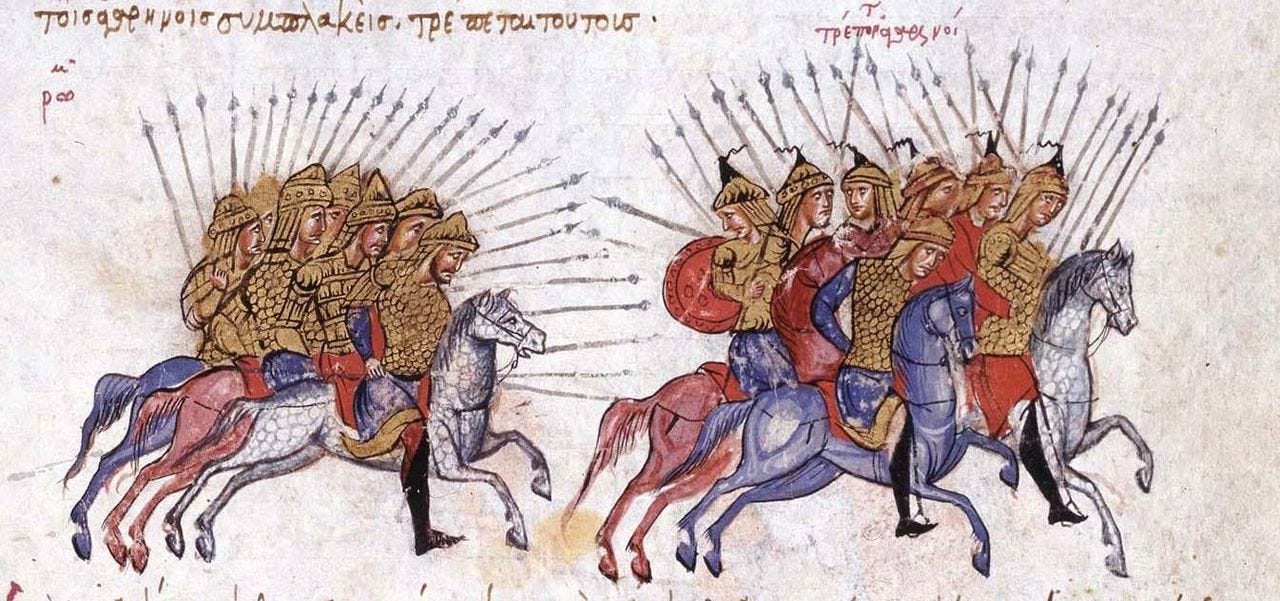
The origins of this method undoubtedly lay in the first century of the wars, but its evolution is invisible to us, hidden by the silence of our sources. But we see an undeniable strategic coherence guiding Byzantine operational art, which was refined and systematized into formal doctrine in the final phase of the conflict (to be covered in Part 3). They learned to frustrate Arab offensives effectively enough that they could not just survive, but grow; this lay the foundation for their own revival even as the Abbasid threat collapsed under its own weight, torn apart by the same combination of centrifugal forces and internal conflicts that overcame their predecessors.
Constantine V
We left off in the previous piece with the succession of Constantine V to the throne in 741. His father, Leo III, had had a long and successful reign: he defended Constantinople during the great siege of 717-18 then fended off a storm of Arab incursions over the following three decades, personally leading the army to victory at Akroinon in 740. This final action of Leo’s reign broke, but did not quite end, the last great Umayyad offensive.
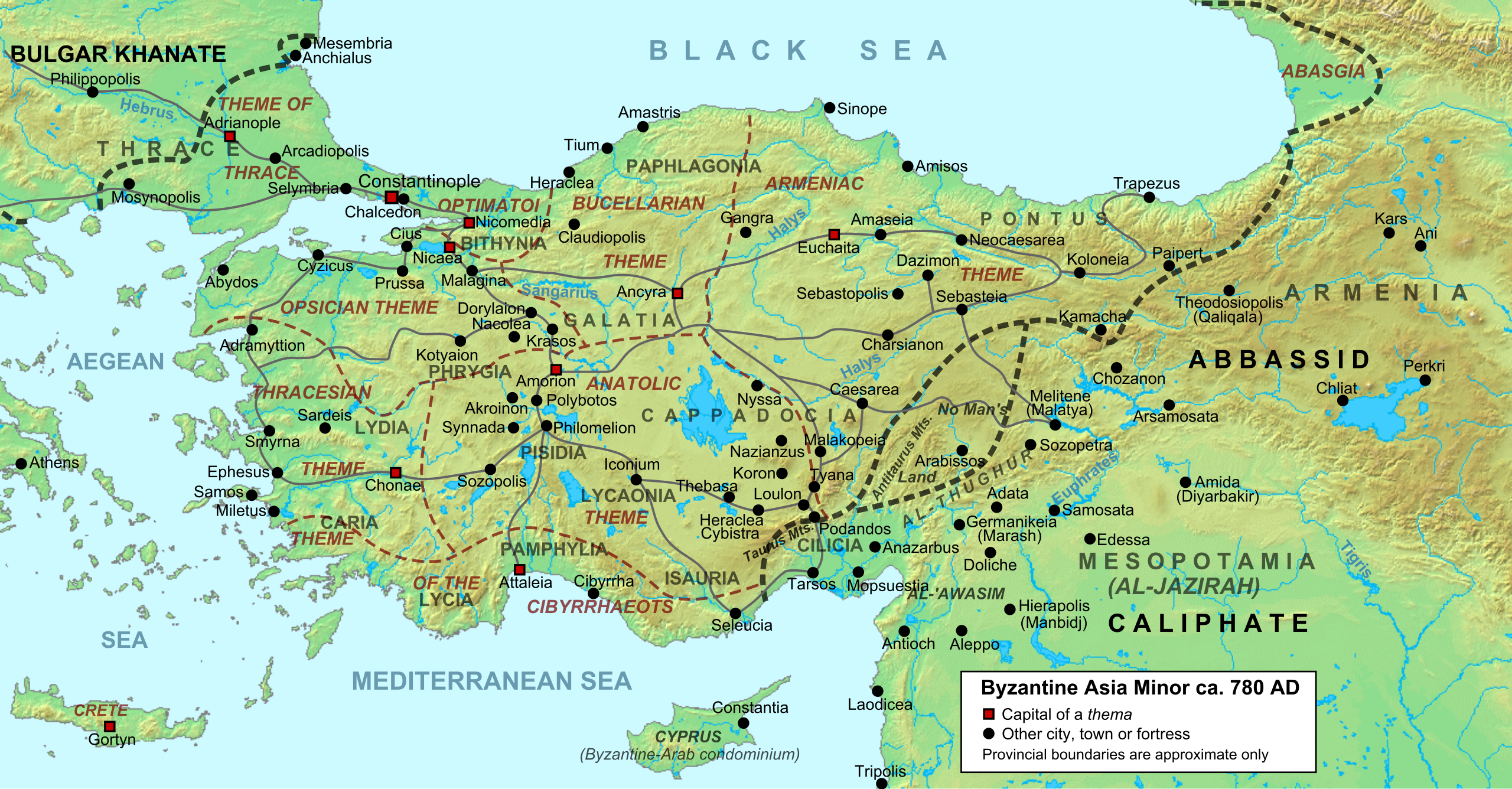
No sooner had Constantine been installed as emperor than he faced a challenger to his rule. Artavasdos had been one of his father’s most trusted lieutenants: as commanding general of the Armeniacs theme, he had aided Leo’s usurpation in 717, and continued to serve him in high civil and military office. Leo further rewarded his friend by giving him a daughter in marriage, which gave Artavasdos influence within the imperial family. He also enjoyed support from much of Constantinople’s aristocracy, owing to his stance in an ongoing religious dispute.1
In the summer of 742, Constantine marched out to press home the advantage against the Arabs and establish his credibility as newly-enthroned emperor. When he reached the Anatolian plateau, Artavasdos assembled his own thematic troops across the emperor’s line of communication and attacked, forcing Constantine to take refuge in Amorion. Artavasdos was proclaimed emperor by his troops, and after spreading the rumor that Constantine had been killed, entered Constantinople in triumph. There followed two years of civil war as Constantine gathered provincial troops and eventually laid siege to Constantinople, taking it at the end of 744.
The Umayyads exploited this to raid Anatolia, which had been left bare of provincial troops. They too were soon wracked by domestic strife, however: the same year that Constantine returned to power, the ruling caliph was assassinated, setting off another round of civil war—the Third Fitna. Even as Byzantium was beginning to recover, reconsolidating around a core of lands in the Balkans and Anatolia, the Caliphate had expanded well beyond what could be centrally controlled: it faced problems on its distant frontiers even as internal tensions mounted.
This was a boon to Constantine. Despite the inauspicious start to his reign, he was able to go on the offensive for the first time in two generations. He had recently reformed the army in response to Artavasdos’ revolt: recognizing the danger of strong provincial armies, he transformed the imperial bodyguard into a stronger permanent force, which became the core of the imperial army, and reorganized the themes around the capital into smaller units. The imperial army could thereby be reinforced by thematic troops for offensive campaigns, and could in turn support the defense of the themes when called upon.
With this new force, Constantine invaded northern Syria in 746. He captured Marash, razed the walls, expelled the Muslims, and resettled its Christian population in Thrace. Byzantine naval power was also on the ascendant: the following year a fleet annihilated an Arab force at harbor in Cyprus.
Abbasid Revolution
A winner was meanwhile emerging from the Arab civil war. The Abbasids, an influential Arab clan, leveraged discontent within the eastern Islamic lands to content Damascus’ rule, and in 750 gained control of the Caliphate. They established the seat of their dynasty in Iraq, where a few years later they founded their new capital of Baghdad.
Although the Abbasids would soon concentrate their energies against Byzantium, Constantine was able to maintain the initiative during the chaos of their early years. In 751, he campaigned in the narrow plains between the Taurus and Anti-Taurus Mountains, where he captured Melitene (modern Malatya), marching off with prisoners and loot after razing its walls. Four years later he did the same to Theodosiopolis (modern Erzurum) in the Armenian highlands.
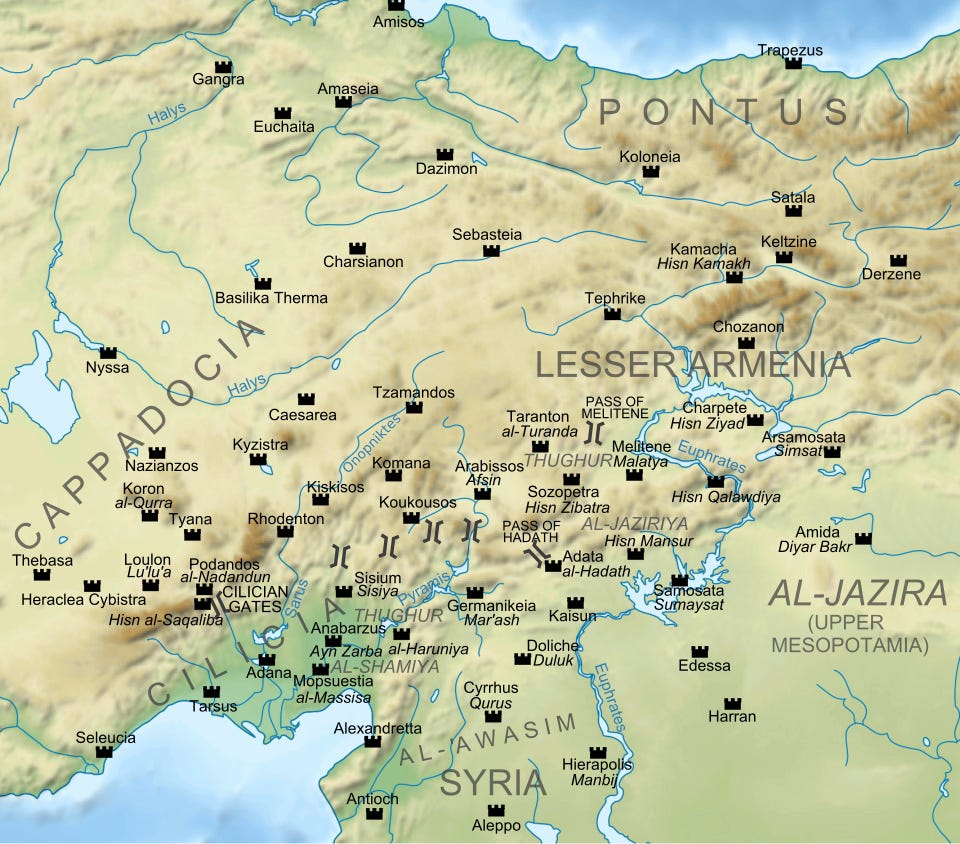
Like his earlier sack of Marash, these were not campaigns of conquest. Rather, Constantine was adopting the Arab strategy of destroying enemy frontier fortifications and depopulating the region, making it vulnerable to further raids. All throughout these years, the Arabs of Syria launched raids of their own into Anatolia—the war was assuming the character of two-way devastation. The two sides agreed to a truce in 757, giving them freedom to take care of pressing demands elsewhere: the Abbasids to consolidate their rule, the emperor to turn to matters in Europe
The Grand Strategic Picture
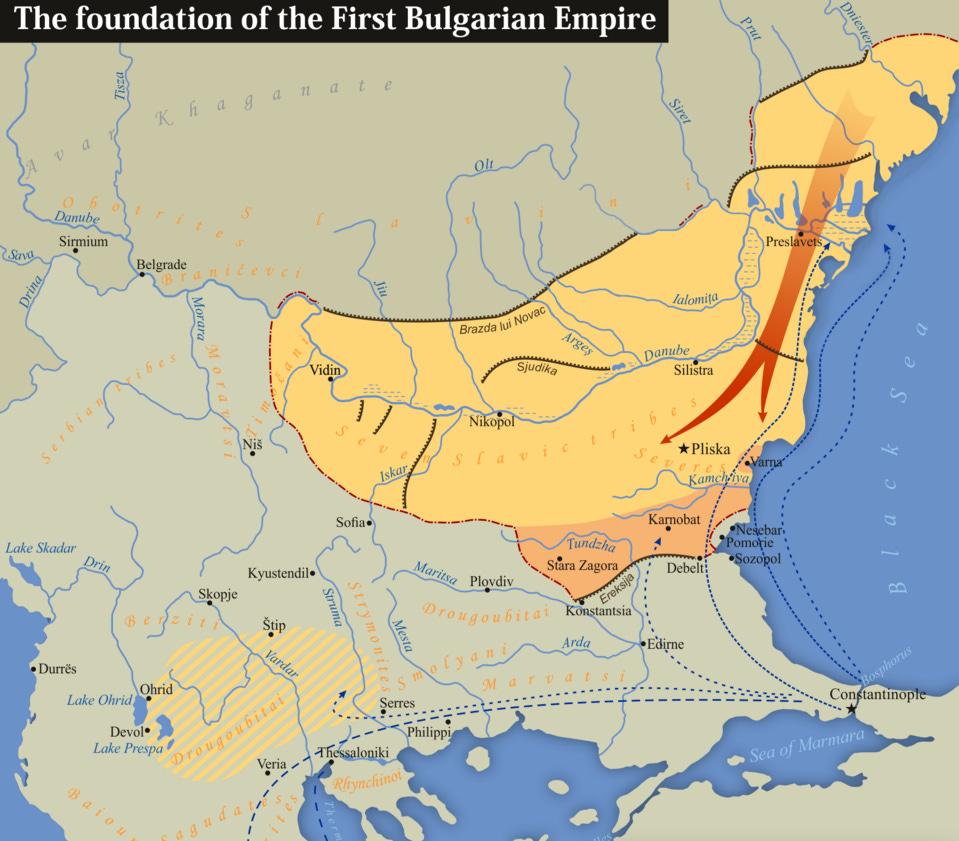
Asia Minor was the most important theater for the Byzantines, but not the only one. In the Balkans, the Bulgars had been expanding from their heartland around the Danube and began making inroads into Thrace.
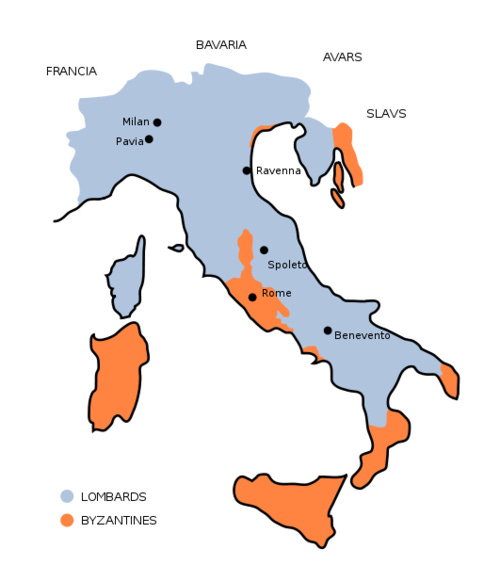
Italy was a third major theater: although Constantinople still controlled large area around Rome, enclaves along the coast, and all of Sicily, they were steadily losing ground to the Lombards, a Germanic people that had invaded the peninsula in the 6th century.
Constantine had to prioritize his efforts between the two, and spent the remaining two decades of his reign focused on the Bulgars—their presence near the capital made them the far greater threat. His resettlement of Christian populations from Marash and Melitene in the Balkans was designed to support garrisons along the frontier, and he was soon able to take the offensive. These campaigns met with mixed success, but the frontier settled along the Balkan Mountains, which run across the northern third of modern Bulgaria.
The Arab-Byzantine truce ended after just a few years, and the Arabs took advantage of the war in Bulgaria to launch semi-regular raids across the Anatolian frontier. Their biggest success came in 770, when they took a border fortress in Cilicia and sacked Laodicea in Cappadocia. This period shows how the Bulgarians could play the part of spoiler: although they never seriously threatened Constantinople itself, their proximity often distracted emperors at inopportune moments.
The Balance of Power
The fighting picked up after 775, which saw a double changing of the guard. Both Constantine V and Caliph Mansur died that year, succeeded by their sons Leo IV and Mahdi. As new rulers, each had a strong incentive to establish his credibility against his greatest foe. Mahdi struck first, with an expedition in 776 that reached as far as Ancyra. Leo was not able to put together a response until 778. Both sides prepared expeditions that summer, but the Byzantines got underway first. They crossed into northern Syria where the enemy was still assembling and inflicted a defeat, spoiling Muslim plans.
Mahdi retaliated with a major incursion the following summer. This raid of 779 furnishes us with our first clear account of the Byzantine operational methods that would later be enshrined in doctrine. A very strong Arab force reached as far as Dorylaeum in western Anatolia. Leo, unprepared to meet the onslaught head-on, sought to evict it by other means. He ordered his thematic generals to strongly garrison all the fortresses in the region, bringing in all the food and fodder they could and burning the rest. He then detailed some 3,000 soldiers—most likely entirely cavalry—to shadow the invaders.
Although only a fraction the size of the enemy (who brought 30,000 regular soldiers plus a large number of volunteers), this corps had a disproportionate effect. By threatening to fall upon any isolated detachments or foraging parties, it forced the Arabs to remain concentrated; yet so large a concentration could not long remain static in arid country which had been stripped of what little it had. After two weeks, the Arabs began their retreat to the frontier. They tried to seize Amorion on the way back, but were quickly dissuaded by its strong garrison and left Anatolia empty-handed.
Both Byzantine and Muslim sources comment on the details of this campaign—one of the latter makes the unusual remark that the invaders neither captured any fortresses nor encountered an army, suggesting that Leo’s strategy was indeed something novel. It was to be a template for Byzantine defensive strategy in the following two centuries.
Harun al-Rashid
As if to compensate for this failure, the Arabs set themselves much less ambitious objectives the following year, capturing a fortress in the mountains near the Cilician Gates. This was led by Mahdi’s son Harun—known to future generations as Harun al-Rashid, whose reign witnessed the height of Abbasid splendor and was semi-mythologized in the Arabian Nights. This modest success was intended to establish his military reputation and prepare the way for his rule.

It was followed in 782 by an expedition on an altogether larger scale. Harun led an enormous army into Anatolia, perhaps the largest yet—one chronicler gives the extremely precise number of 95,793 men. The Caliphate was at peace on all other frontiers, and could draw volunteer warriors from a vast area—the chronicles enumerate the enormous quantities of coin that Harun brought with him to pay his soldiers.
The timing could not have been worse for Byzantium. The immediate cause for the expedition was domestic strife that the Abbasids hoped to exploit. Leo had died in 780, and his widow Irene deposed packed their son Constantine VI off to a monastery, assuming direct rule herself. This by itself did not set back its military capacity—in 781, a force headed off an Arab raiding party at a mountain pass, preventing them from penetrating Anatolia. But a general she had appointed to command in Sicily proved disloyal, and she dispatched a large expedition to bring the traitor to heel.