
The modern system of combined arms discussed in last Dispatch shows no sign of going away in the 21st century. If anything, it is more important than ever before: the disciplined use of cover, concealment, suppression, and combined-arms integration have proven critical for the few offensive gains eked out on various battlefields in recent years. It is therefore worth briefly considering how force structure might evolve in response to the current environment.
In the spirit of Combined Arms Warfare in the Twentieth Century, it is worth looking at two questions in particular: the overall balance of separate arms and the level at which they are integrated. In the second half of the twentieth century, for example, infantry, tanks, and artillery were often combined in tactical units at a 3:1:1 ratio. Depending on the time and place, those ratios could be preserved down to the battalion level, with a mortar battery serving as artillery.
As drones have come into their own, this question of balance has come back to the fore. Drones in Ukraine at first mostly served to complement artillery by acting as spotters, then only as FPV drones proliferated principally become direct-strike weapons; in both cases, they have served the function of fires. Given the sheer number of drone units at all echelons, however, this has tilted the ratio of fires to infantry from the traditional 1:3 ratio toward something closer to parity.
Yet the problem posed by enemy drones also shapes force structure. Protection is absolutely vital, taking two major forms: expedient passive defenses and active counterfire. Maneuver units must dig in when they are not moving, and must have anti-drone protection whenever they are. Together with the need to defeat minefields and other counter-mobility measures, it might therefore eventually make sense to aggregate engineering and anti-drone assets into units of a single type—giving commanders a unified element dedicated to planning and resourcing movements.
If the fundamental combined-arms problem of the 20th century was integrating infantry, armor, and artillery, that of the 21st-century may prove to be:
Maneuver (whether infantry or armor)1
Fires
Mobility (anti-drone/engineers)
Balancing and Integrating
This says nothing about the particular balance of combined arms. Even if the sheer quantity of drones makes fires approach maneuver elements in size, current fighting may mislead us as to future proportions. Although FPVs are extremely useful on a static front where drone teams can spend a lot time seeking out individual targets, so many units could well prove to be a hindrance for faster-moving formations.
Then there is the second fundamental question of force structure: how to integrate separate arms across echelons. An earlier Dispatch looked at this problem at the brigade level, considering the possibility of reintroducing intermediate regiment-sized formations to help coordinate all the supporting units a single infantry battalion requires—engineering, EW, C-UAS, etc.
Likewise, militaries may simply reduce the infantry in a brigade to a single battalion, and keep most supporting units at a higher echelon. This would loosely resemble the USMC’s current Marine Littoral Regiment, wherein the maneuver element (the Littoral Combat Team) is supported by an anti-air battalion and a logistics battalion. Much of the final answer will come down to how much mobility support proves necessary to allow movement, and whether that is worth the cost.
The Promise of Combined Arms
Mere survivability demands low-level integration of all arms as a matter of course. C-UAS defenses must be integrated at the company and below, just as drone teams are already included in squads and platoons. Similarly, some observers have argued that each infantry battalion requires one organic excavator at a minimum.
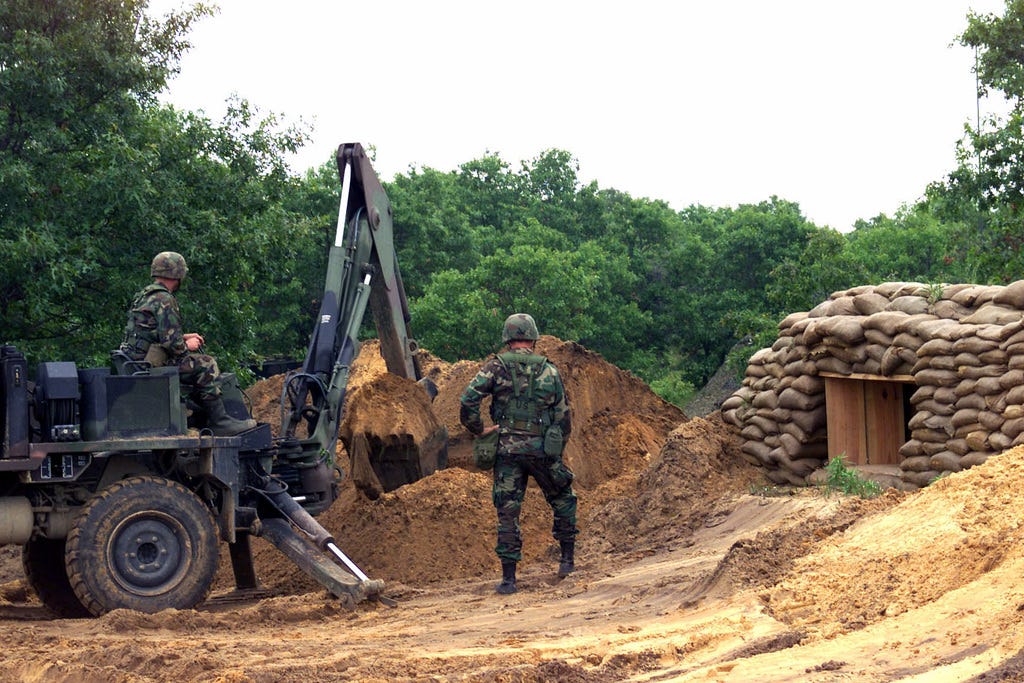
Counterintuitively, then, offensive success hinges on integrating arms at higher levels. It will be difficult for any army to mount a sustained offensive without large-scale counter-drone defenses and the ability to rapidly get large formations under cover. Just as armored divisions and corps once swept across Europe, we may see comparably-sized engineering units paving the way for future offensives.
While I personally believe that armor has a future on the battlefield, it is quite possibly disappearing as an independent arm. The most successful mechanized assaults of the past few years have been small in scale, involving just a handful of tanks supporting comparable numbers of IFVs; whether it makes sense to preserve armored brigades or divisions as distinct units remains to be seen.
Thank you for reading the Bazaar of War. Most articles are free for all to read, but a subscription option is available to all who wish to support. Subscribers receive a pdf of the critical edition of the classic The Art of War in Italy: 1494-1529, and will have exclusive access to occasional pieces.
You can also support by purchasing Saladin the Strategist in paperback or Kindle format.
Excellent article. Just as integration of armor changed the battlefield dynamic, Drones are the same. Offensive technology has outpaced defensive; a rebalance is inevitable to continue being combat effective going into the future.
Likewise, drones are just another tool in the tool box, they are not going to completely replace other tools as long as technology and methods continue to develop.