
Between 1942 and 1944, the world witnessed two simultaneous tactical transformations. In the Pacific, American carrier groups underwent a dramatic shift. The number of AA guns on flattops and escort vessels more than doubled, while the introduction of proximity fuses and improved fire control made them much more deadly. Air wings were rebalanced to give them an outright majority of fighters, at the expense of dive bombers and torpedo planes, while improved radar direction increased their effectiveness in intercepting enemy attacks.
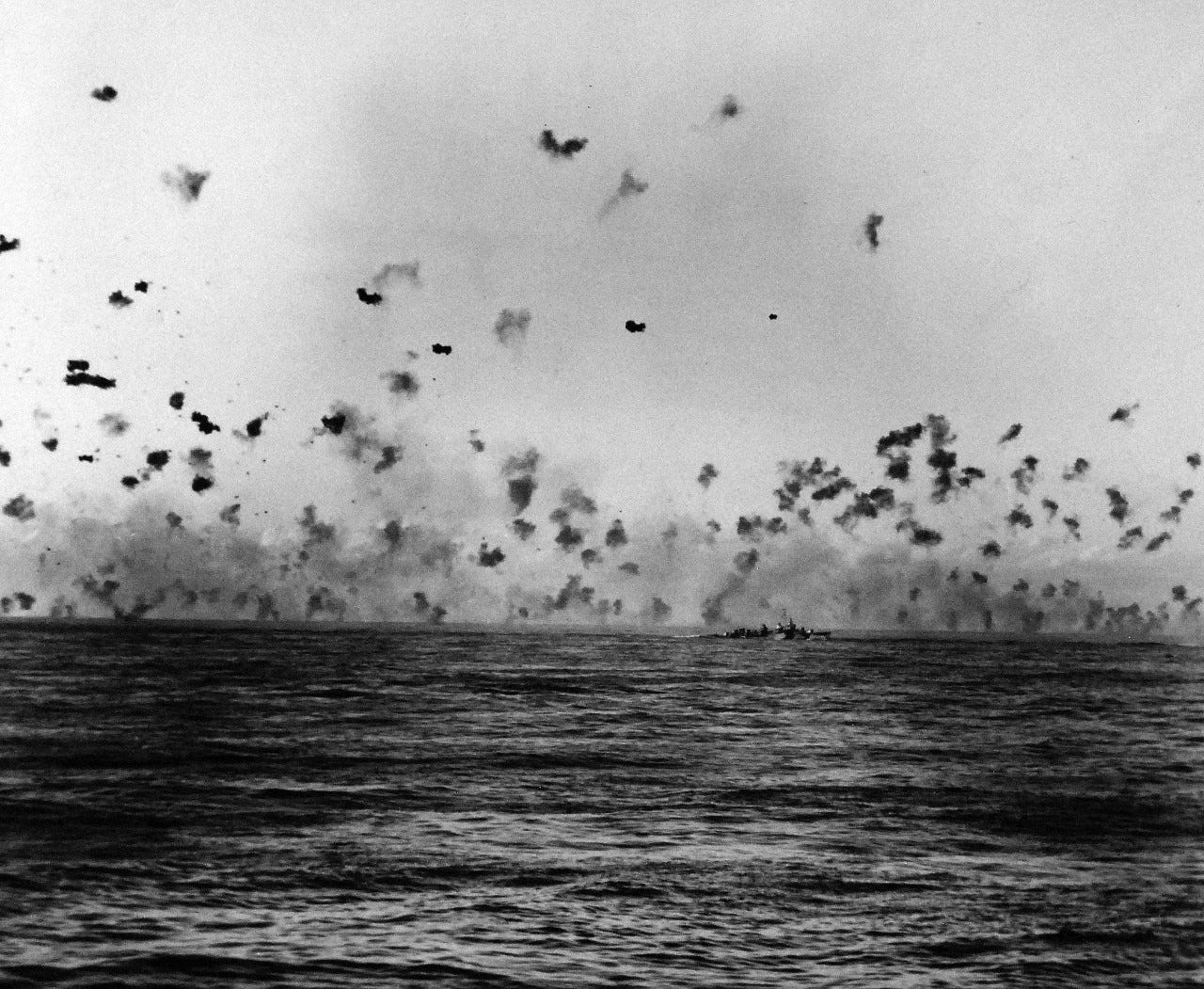
This shift in favor of the defense completely transformed carrier battles. Instead of resembling “two blindfolded men with knives in a ring”—meaning the first to strike was likely to knock out the enemy’s carriers—American task groups could afford to stand their ground and slug it out with incoming Japanese aircraft. This was just as true against their surface vessels as against land targets: whereas the Pacific Fleet was loath to remain offshore for very long during the tough fighting on Guadalcanal and Tarawa in 1942-43, they pummeled the Marianas and Philippines for extended periods in 1944.
Half a world away in the European theater, other military establishments were undertaking serious efforts to bolster their principal striking arms. During the first three years of fighting, German Panzers often found themselves alone once they penetrated fragile defensive lines, racing ahead of their supporting infantry and artillery. Following their early victories in Poland, France, Russia, and Ukraine, however, they began to struggle as the Soviets got better at implementing their prewar doctrine of defensive depth.
The only answer was to restore the combined-arms balance at the point of the spear. The number of tanks in a Panzer division was slightly reduced, while a greater proportion of their infantry was mounted in half-tracks and they were given additional self-propelled artillery that could keep up with the armor (along with flak guns to serve in both an anti-air and anti-tank role). This made it possible to endure fierce counterattacks when set upon far from friendly lines.
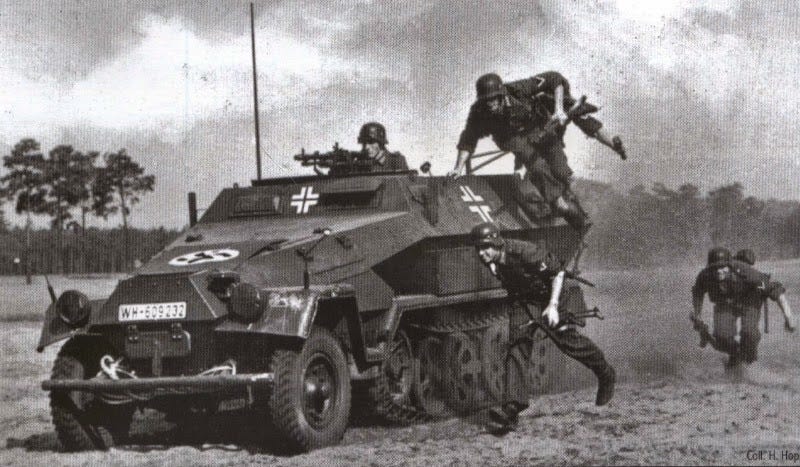
German offensive power was nearly exhausted by 1944, but their adversaries mirrored these changes. While increasing the number of tanks in a tank corps (which were severely understrength in the chaotic early years), the Soviets greatly increased the quantity of self-propelled artillery and supported them with mechanized corps in the exploitation. The British and American armies, which did not have especially sophisticated combined-arms doctrines going into the war, developed balanced formations of their own as they improved.
On the whole, these tactical changes on land were less drastic than those in US carrier groups, but they decisively settled prewar debates over the employment of armor. Well-integrated mobile formations, supported by airpower, would dominate land warfare for the remainder of the 20th century. Although the precise balance changed over the following decades in many particulars, this basic template proved to be a remarkably stable equilibrium: accounting for correlation of forces, victory tended to go to the side that could better execute modern tactics, not necessarily the side that was on the bleeding edge of innovation.
Paradigm Shifts
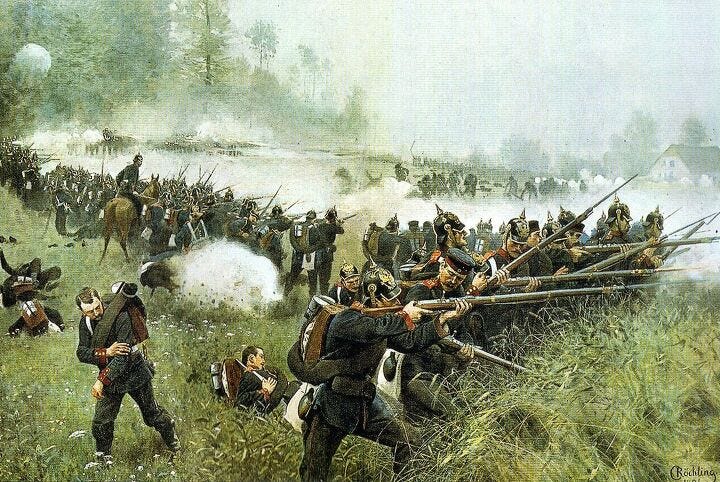
Ever since Spanish infantry tactics swept across Europe after the year 1500, homogenizing the highly-variegated regional and national styles, Western warfare has moved through a series of tactical paradigms. The checkerboards of pike-and-shot squares that emerged in the 16th century gradually gave way to more extended linear fronts in the 17th, which predominated until modern artillery and machine guns forced a major revision in the 20th.
There was plenty of tactical evolution within these various systems, dictated by technology and circumstance. Napoleonic tactics were different in important ways from those of the 18th century, and different still from those of the Wars of German Unification. Field guns came to play an increasingly important role in pike-and-shot warfare. But the overriding tactical logic of each system remained more or less the same, dictated by the technology of the age.
Many have noted how this is similar to Thomas Kuhn’s model of scientific revolution: new discoveries prompt constant revision to existing theories, but do not change the underlying concepts—until a startling new discovery or the accumulation of a mass of contradictory evidence prompts the wholesale adoption of a new theory.
Most tactical changes since 1940 have been examples of the former. The deadly employment of Soviet-made antitank weapons in the Yom Kippur War did not herald the end of armored tactics, but did prompt important changes (in fact, it was the previous few years that marked an anomalous high point of supposed invulnerability for armor). Evolutions in airpower all the way through the Gulf War changed the combined-arms and air support requirements for ground maneuver, but did not fundamentally alter how they fought. The package of tanks, radios, motorization, and aircraft, by contrast, marked a paradigm shift from the style of warfare of just twenty years before.
There is no one way by which paradigm shifts occur. Sometimes they emerge from periods of intense competition: pike-and-shot tactics were developed during the intense competition of the first decades of the Italian Wars, while the “modern system” of tactics were born only in the maelstrom of World War I—although infantry firearms and quick-firing artillery had existed for decades before either of these conflicts, it took the pressure of sustained fighting to effect these transformations. Linear tactics, by contrast, evolved far more gradually as the growing reliability of muskets coupled with adoption of the bayonet favored broader deployments to maximize firepower.
In contrast to both these models, the land and naval tactical systems of World War II were broadly outlined well in advance, but underwent another rapid period of adaptation over subsequent years of fighting. German and Soviet military leaders envisioned bold armored thrusts, while Japanese, American, and British navalists foresaw the potent role of carrier aviation.
The Age of Perpetual Revolution
What separates the naval example from the others is that the changes between 1942 and ’44 were substantial enough to constitute another paradigm shift in themselves. Granted, the wider operational picture was not comparable in the later period. Three years of non-stop combat had taken a dreadful toll on the Japanese corps of naval aviators—the best in the world at the start of the war—while their training pipeline was too narrow to replace losses. Submarine and air attacks had likewise taken a serious toll on Japanese shipping, choking off fuel to the surface fleet (which itself had suffered serious attrition in tonnage and personnel). In spite of all these disadvantages, the Japanese managed to sink an American light carrier by conventional air attack at Leyte Gulf, the last great carrier battle of the war, despite being outnumbered 5-to-1 in total aircraft, and also managed to sink an escort carrier by kamikaze.
Naval warfare is moreover a completely different beast from land warfare. There have been no major fleet actions in the 80+ years since Leyte Gulf: not only does it require extraordinary circumstances for two great sea powers to go to war, but the outsized vulnerability of surface fleets to modern weapons since the early 20th century makes them far less likely to risk decisive battle.
Nevertheless, if the war lasted several more years and the two sides remained evenly matched, there very likely would have been yet another paradigm shift. Improvements to torpedoes and innovation in submarine tactics would have shaped the mix of escort ships, while the introduction of longer-ranged land-based bombers would have altered the concepts of employment for carrier aviation. Naval tactics, by virtue of being so sensitive to technological change, are inherently less likely to settle on a stable equilibrium.
Technology and Tactics
Even though land concepts are correspondingly more conservative, it follows that accelerating technological change should increase the speed of paradigm shifts. Unmanned systems have arguably already done that: while Operation Vivaldi has shown that tanks are by no means obsolete, the combined-arms equilibrium has certainly been altered. If commonplace comparisons to the First World War are apt (in the operational, if not in the precise tactical sense), then both sides now resemble the armies of 1917-18: they have learned how to conduct offensives in the new environment, if not necessarily with decisive results.
The great open question is how long it will take for the next paradigm to emerge. The next major war will certainly look very different in the particulars, but even the broad outlines might also be very different. New concepts of protected mobility and of hardened supply lines to sustain advances could radically alter the current equilibrium; with sufficient ground-based fires, even small units could come to resemble 1944-era carrier groups against the aerial threat.
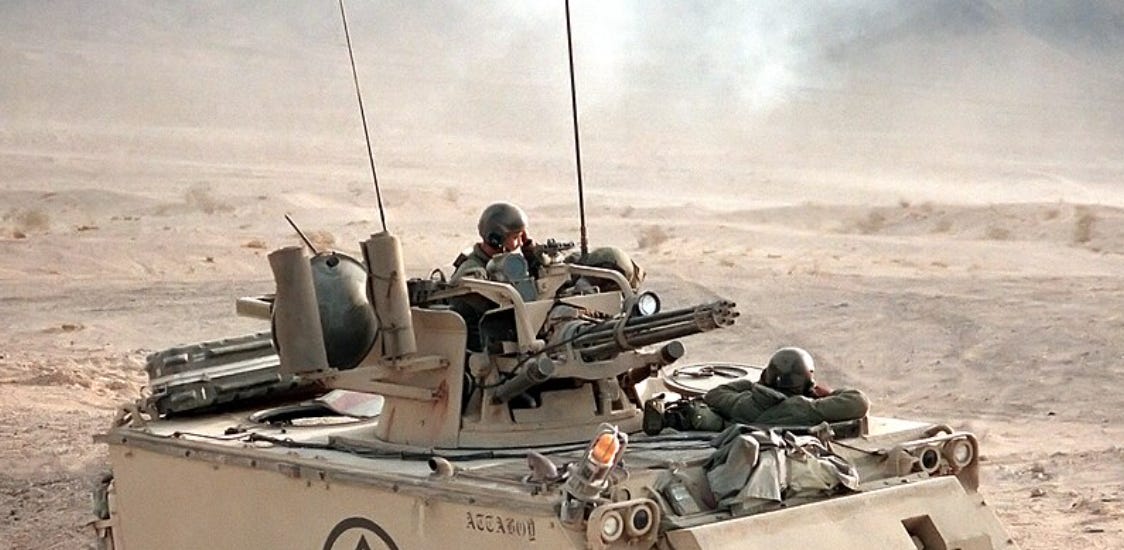
But that would only answer the immediate challenges facing ground forces. Expanding production of ballistic missiles, increased autonomy, space-based weapons, and attacks on civilian infrastructure have the potential to transform existing tactical schemes many times over. Future equilibria might prove short-lived indeed.
Thank you for reading the Bazaar of War. Please like and share if you enjoyed, it helps more people find this. You can also support with a paid subscription, supporters receive the critical edition of the classic The Art of War in Italy: 1494-1529 and get access to exclusive pieces.
You can also support by purchasing Saladin the Strategist, in paperback or Kindle format.
It's interesting how the Germans and Soviets basically got the right concept from the start, but there was a lot more debate in Anglo-French forces.
It is rather ironic that Kuhn himself wrote that his concept had no application beyond the field of physics, perhaps having missed the truth that he was talking about a human behavior having therefore application in any field of human endeavor. On the mechanization of infantry during WW2, both DeGaulle and Guderian among others foresaw the necessity of mounting both infantry and artillery on wheels or tracks in order to keep them with the tanks. What was lagging was defense budgets and the related technology.