
One of the frustrating things about much of the early commentary around the Iran war was how it framed the relationship between military force and political objectives. This went deeper than the wishful thinking that is always rife at the outset of a war—e.g. statements implying that airpower alone could effect regime change, met by equally absurd claims regarding Iran’s ability to knock out US aviation. Even more thoughtful commentators discussed victory in essentially military terms, conflating the understanding of war as a contest between adversaries with war as a means to a political end.
The reasons for distinguishing between the two are neither obscure nor subtle. Once begun, war takes on a logic of its own, entirely separate from the ends toward which it is employed. The enemy has a will of his own, meaning efforts must be sustained until he is either defeated or brought to terms—which naturally risks drawing the two sides into an invidious escalation cycle. Even assuming that that can be managed successfully, history produces a litany of examples of battlefield victories that did not produce the desired results. The overriding task of strategy—to ensure that the contest serves its intended political aim—is difficult in the best of times.
What has thrown people off about the Iran conflict is that the relationship between the two is even less straightforward. This is partly because the fighting has mostly been limited to exchanges of drones and missiles, making kinetic escalation easier to manage—as of the time of writing, a ceasefire remains in place pending negotiations, despite a few exchanges of fire. But more fundamentally, the Iran war is not a conventional war at all.
Military Force and Leverage
The sheer asymmetry of forces fielded by the US and Israel against Iran makes the contest inherently more like a counterinsurgency than a typical interstate war. In such a conflict, the weaker party loses any head-to-head clash, but so long as it can survive (as almost any regime can against air power alone), it has a strong incentive to expand the scope of the contest to a domain where it holds a comparative advantage.
In the present case, that comparative advantage is economic pressure. As soon as the Strait of Hormuz was closed, the conflict ceased to be a “war” in any typical sense: even as Iran’s offensive capabilities were steadily degraded, it maintained the looming threat of global economic catastrophe. Barring a drastic and politically-unwelcome expansion of the conflict’s horizons—doubtlessly to include ground troops—any straightforward relationship between military force and political objectives was severed.
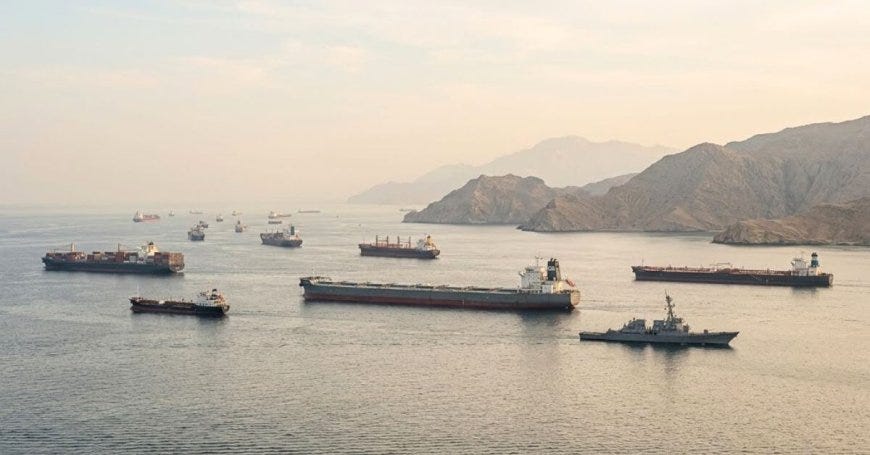
This defies intuitive categorization. The war does not look much like other asymmetric conflicts such as Afghanistan or Vietnam, where local forces only triumphed through sheer endurance. Despite the Iranians’ military weakness, they hold uniquely potent leverage, leaving little response aside from negotiations or dramatic escalation. At the same time, the drones and ballistic missiles that Iran continues to launch give the illusion that the conflict is a lot more conventional than it in fact is.
As a result, many have defaulted to treating this as a typical war—i.e. to focus on the military contest, not the strategic aims. Once Iran’s military capabilities are completely reduced, this line of thinking goes, the Strait can be reopened and terms imposed. Tallies of destroyed SAMs and missile launchers are cited to this end, just as body-counts were once wielded during Vietnam. Yet opportunity costs make oil carriers far more sensitive to the threat of force than militaries, and it is the logic of global commerce that dominates strategic dynamics at present.
Divergent Objectives and the Question of Honor
Ironically, these same patterns of thought have led Americans to neglect the lessons from one of their great strategic triumphs in the 20th century: Korea. In terms of political objectives, that war was an unquestionable success for the United States and allies: they expelled the North Korean and Chinese invasion from South Korea and secured an armistice to guarantee the latter’s safety. Only from the perspective of the frontline was it anything less: as an unwanted and unpopular war that incurred heavy losses and embarrassing reverses, it lacked the satisfying resolution of the recently-concluded World War II.
The US certainly had the ability to press on to total victory by 1951 or ’52, and many field commanders urged just that. Truman recognized that doing so might sacrifice strategic aims to the contest itself, however. Occupying North Korea was never a pressing priority, and getting more deeply involved would have given Stalin a prime opportunity to invade Western Europe—an acute worry just four years after the Soviets acquired the bomb.
This hints at a way out of the present impasse. Military contests are necessarily zero-sum (or negative-sum), but strategic objectives are not. If Korea was a strategic victory for the US, it was also a victory of sorts for Mao: just a year after his victory in the Chinese Civil War, he demonstrated that the fledgling Communist state could go toe-to-toe with one of the world’s greatest military powers. Although he failed in his immediate aim of driving the US out of Korea, the question of national honor gave him a limited victory.
So too for the US in the War of 1812. Although a costly and ill-though-out war that ended in a draw on the battlefield, it was greeted as a triumph: by showing their willingness to fight the naval superpower of the age over what was essentially a question of honor, Americans won a kind of moral victory that likely ensured better treatment on the high seas in following decades. Indeed, honor is far more than an irrational sentiment in strategic competition: it can act as a deterrent and gives political leaders room to maneuver at home. At the negotiating table, this makes it a potent bargaining chip.
It was precisely the question of honor that allowed the eventual detente between Egypt and Israel following the 1973 war. Although the fighting ended with the Egyptians in a militarily untenable position, their Third Army completely encircled, the UN-imposed ceasefire prevented the Israelis from destroying it altogether. Sparing the Egyptians this humiliation, coupled with their creditable performance earlier in the war, gave Sadat the political capital to reach a lasting settlement with Israel (although unfortunately not enough to save his life).
This does not make the present negotiations easy. Giving the enemy an honorable exit requires great restraint by the stronger power, and can incur political costs of its own—it certainly would in the present case, where Iran stands to gain tremendous prestige—and there are many other practical obstacles besides.
Beyond Iran
In light of the glaring facts that 1) airpower was always bound to be insufficient for regime change and 2) Iran’s leverage was much greater than acknowledged, the distinctions outlined above may seem too fine. The current imbroglio is the product of much grosser planning failures than mere misaligned military theory.
The low quality of the general discourse is nevertheless concerning, as it reflects a widespread inability to discuss the relationship between military force and political objectives in conflicts other than full-scale war. This follows two decades of GWOT, during which Western military establishments never developed a good working model for counterinsurgency; what few lessons were learned were left half-digested once attention abruptly shifted back to conventional war in 2022.
For a plethora of reasons, asymmetric and irregular conflicts are likely to remain the most common uses of military force. Without a good framework to think about these things, the same mistakes are likely to be repeated.
Thank you for reading the Bazaar of War. Most articles are free for all to read, but paid subscriptions are available to all who wish to support. Subscribers receive a pdf of the critical edition of the classic The Art of War in Italy: 1494-1529, and get exclusive access to monthly long-form pieces exploring selected topics in depth.
You can also support by purchasing Saladin the Strategist in paperback or Kindle format.
I think the reason a lot of commentary focuses on depletion of military munitions, at least from political officials, is that most everyone acknowledges the US is severely disadvantaged in terms of economic leverage.
Deep analysis, but I think it gives the Iranian regime too much credit. Its survival is not proof of strategic genius. It is a mix of repression, fanaticism, corruption, and Europe’s repeated failure to support the Americans and Israelis when they try to stop it.